Table of Contents
Meta description (overall): Learn exactly how to perform the Single-Arm Dumbbell Chest Press with perfect form, discover its science-backed benefits, muscles worked, common mistakes, variations, and how to program it for muscle building, strength training, and better overall fitness.
Introduction
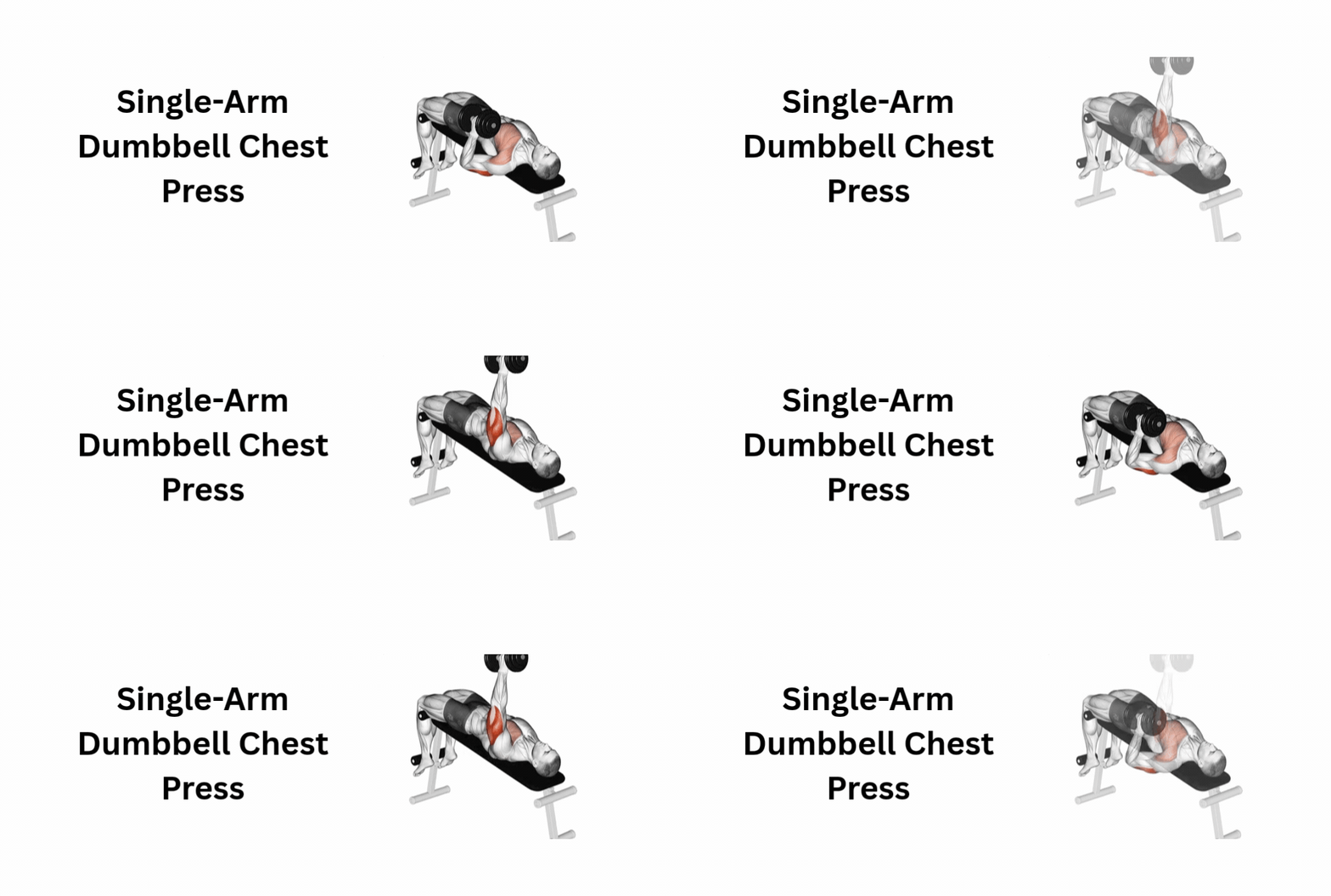
The Single-Arm Dumbbell Chest Press is a powerful variation of the classic dumbbell bench press that combines upper-body muscle building with serious core stability and coordination work. Instead of pressing with both arms at the same time, you use only one dumbbell, which forces your body to fight rotation and stay stable. This simple change turns a standard chest exercise into a full-body strength training challenge.
Because the load is on one side, your pectorals, triceps, and front deltoids must work hard to move the weight, while your core muscles (especially the obliques and deep stabilizers) work equally hard to keep you from tipping or twisting. Over time, this can improve muscle symmetry, joint stability, and even your performance in other big lifts like the barbell bench press or push-ups.
The Single-Arm Dumbbell Chest Press is popular among:
- Lifters who want to fix left–right strength imbalances
- Athletes looking for more functional strength and anti-rotation core training
- Home and gym users who want a highly effective upper-body workout with minimal equipment
You can perform the Single-Arm Dumbbell Chest Press on a flat, incline, or decline bench, or even on the floor, making it a flexible addition to almost any workout program. When done correctly, it is both safe and highly effective for muscle building and overall fitness.
Benefits of Single-Arm Dumbbell Chest Press
Meta description (Benefits): The Single-Arm Dumbbell Chest Press offers unique benefits, including muscle symmetry, core activation, shoulder health, and strength gains. Learn the key advantages and the science behind them.
1. Corrects Left–Right Muscle and Strength Imbalances
Using only one dumbbell at a time forces each side of your body to work independently, which helps identify and correct muscular imbalances.
- In a barbell bench press, your stronger side can subtly dominate the lift.
- With the Single-Arm Dumbbell Chest Press, the weaker side can no longer “hide” behind the stronger side.
- Over time, balancing the load and volume on each arm can help even out strength and muscle size.
Unilateral training (single-limb training) is widely used in strength and conditioning to address asymmetries and improve performance and reduce injury risk. While most research looks at unilateral leg training, the principles of balancing load and improving neuromuscular control apply equally to the upper body.
2. Builds Powerful Chest, Shoulder, and Triceps Strength
The Single-Arm Dumbbell Chest Press primarily targets the pectoralis major (the main chest muscle), with strong involvement from the anterior deltoid (front shoulder) and triceps brachii (back of the upper arm).
Because the exercise is still a heavy horizontal push, it is highly effective for:
- Muscle hypertrophy (growth) in the chest
- Strength development in the pressing muscles
- Carryover to barbell bench press, push-ups, and sports that involve pushing
Dumbbell pressing in general allows a slightly greater range of motion and more natural shoulder path compared with a barbell, which may enhance muscle activation of the pectorals in some lifters when performed with good form.
3. Trains Core Stability and Anti-Rotation Strength
One of the biggest advantages of the Single-Arm Dumbbell Chest Press over bilateral presses is core activation. Because the weight is only on one side, your body naturally wants to rotate or tip. To resist this, your obliques, transverse abdominis, spinal stabilizers, and glutes must fire to keep you square on the bench.
BarBend specifically notes that the single-arm dumbbell bench press challenges counter-rotation and requires full-body tensionquads, glutes, and core includedto keep the torso stable. This “anti-rotation” demand makes the movement not just a chest press, but a functional full-body stability exercise.
Improving anti-rotation strength can:
- Support better posture
- Protect the spine under load
- Improve performance in sports and daily activities that involve resisting or controlling rotation
4. May Improve Shoulder Health and Joint Stability
Many lifters find that dumbbell pressing feels more comfortable on their shoulders than barbell pressing, because the shoulders can move in a more “natural” arc and the grip is not fixed.
Key shoulder-friendly characteristics:
- You can adjust your elbow angle (often around 30–45° from the torso) to reduce stress on the shoulder joint.
- You are not locked into a single bar path, allowing your shoulder joint to move a bit more freely.
- The unilateral loading encourages the stabilizing muscles around the shoulder (like the rotator cuff) to work harder to control the weight.
While this is not a rehab prescription, many coaches use the Single-Arm Dumbbell Chest Press as a way to continue effective upper-body strength training with less shoulder irritation, provided the lifter uses smart loads and correct technique. For broader background on shoulder structure and joint safety in strength training, see resources such as ACE Fitness and similar professional organizations.[ACE Fitness – high-level guidance on safe pressing mechanics]
5. Increases Mind–Muscle Connection and Technique Awareness
Because you are focusing on one arm at a time, you can pay more attention to:
- Pressing path
- Elbow position
- Scapular (shoulder blade) positioning
- How your chest and triceps feel throughout the movement
This can improve your mind–muscle connection, which is associated with better muscle activation and potentially better hypertrophy when used with moderate loads and controlled tempo.
Additionally, the instability of the movement encourages slower, more controlled reps, which can reinforce proper bench press mechanics that transfer to other lifts.
How to Perform Single-Arm Dumbbell Chest Press
Meta description (How-to): Learn exactly how to perform the Single-Arm Dumbbell Chest Press with step-by-step instructions, including setup, execution, breathing, and practical tips for perfect form and safety.
Equipment Needed
To perform the Single-Arm Dumbbell Chest Press, you need:
- One dumbbell of appropriate weight
- A flat bench (or incline/decline bench if using variations)
- Optional: a spotter if lifting near your maximum or if you’re a beginner
You can also perform a floor version if you don’t have a bench, which slightly limits range of motion but increases safety for some lifters.
Step-by-Step Instructions
Setup
- Position the bench and dumbbell
- Place the dumbbell next to the bench where you can easily pick it up.
- Sit near the edge of the bench with the dumbbell resting on your thigh.
- Lie back with control
- Carefully lean back onto the bench while guiding the dumbbell to your chest with both hands if needed.
- Once lying down, place your feet flat on the floor in a stable, slightly wide stance for balance.
- Find your five points of contact
- Both feet flat on the floor
- Glutes, upper back/shoulder blades, and head firmly on the bench
- Set your shoulder blades
- Retract and slightly depress your shoulder blades by “pinning” them into the bench.
- This creates a stable base for pressing and protects the shoulder joint.
- Position the dumbbell
- Hold the dumbbell directly over your chest with your arm extended but not hyperlocked.
- Your wrist should be stacked directly over your elbow.
- Use a neutral to semi-pronated grip (palm facing in or slightly rotated forward) depending on what feels best for your shoulders.
- Non-working arm position
- You can:
- Extend the non-working arm straight toward the ceiling (mimicking the same position as the working arm), or
- Place it out to the side or on your hip for counterbalance.
- Extending it upward often helps maintain even shoulder blade positioning.
- Brace your core
- Tighten your core, glutes, and legs to create full-body tension.
- Your torso should feel locked in and resistant to rotation.
Execution
- Lower the dumbbell (eccentric phase)
- Inhale as you slowly lower the dumbbell toward the side of your chest.
- Keep your elbow at about a 30–45° angle from your torsonot flared straight out and not tucked completely in.
- Control the descent; do not let the dumbbell drop.
- Aim to bring the dumbbell to about mid-chest level, slightly outside your chest line.
- Pause briefly
- Lightly touch or come just above the chest without bouncing.
- Maintain tension in the chest, shoulder, triceps, and core.
- Press the dumbbell up (concentric phase)
- Exhale as you press the dumbbell upward and slightly inward over your chest.
- Keep your wrist stacked over your elbow and your forearm vertical.
- Drive through your chest, triceps, and shoulder while pushing your feet into the floor and maintaining core tension.
- Lockout and reset
- At the top, your arm should be extended but not aggressively locked.
- Keep the shoulder blades pinned; do not shrug.
- Maintain square shoulders; your body should not twist or rotate.
- Complete the set and switch sides
- Perform all your reps on one side.
- Carefully bring the dumbbell back to your chest and sit up with control.
- Switch the dumbbell to the other hand and repeat.
Repetitions and Sets
General guidelines (adjust for your goals and experience):
- Muscle building (hypertrophy):
- 3–4 sets of 8–12 reps per arm with a challenging but controllable weight
- Strength-focused:
- 3–5 sets of 4–6 reps per arm with heavier loads and longer rest (2–3 minutes)
- Endurance/conditioning or accessory work:
- 2–3 sets of 12–15 reps per arm with lighter weights and shorter rest (60–90 seconds)
Start with lighter weights until your technique and stability are solid. Remember you are not just pressing; you are also resisting rotation, which increases the real difficulty relative to your usual dumbbell bench press loads.
Additional Tips for Success
- Start on your weaker side
Begin each set with your weaker arm. Match the reps and weight with your stronger side to help balance strength.
- Use a controlled tempo
Lower the weight in 2–3 seconds, pause slightly at the bottom, then press up with intent but not with jerky speed. This increases time under tension and improves control.
- Keep your elbow angle consistent
A 30–45° angle from your torso is usually safest and most effective for chest activation while protecting your shoulders.
- Do not over-arch your lower back
A natural, small arch is normal, but avoid excessive arching. Keep your core engaged and ribs slightly down.
- Breathe properly
Inhale on the way down, exhale as you press up.
For heavy sets, you may use a brief Valsalva (holding breath during the hardest part) if you know how and have no medical issues that contraindicate it.
- Use a spotter or lighter weight if unsure
Especially when you’re still learning the Single-Arm Dumbbell Chest Press, prioritize safety and control over loading.
Common Mistakes to Avoid
Meta description (Mistakes): Avoid these common Single-Arm Dumbbell Chest Press mistakeslike flared elbows, unstable core, and excessive back archto protect your shoulders and maximize muscle activation.
1. Flaring the Elbow Too Wide
Letting the elbow flare out to almost 90° from the torso increases stress on the shoulder joint and can reduce mechanical efficiency.
- Aim for a 30–45° angle from the torso throughout the movement.
- This position distributes load across the chest and shoulders more evenly and is often more joint-friendly.
2. Allowing the Torso to Rotate or Tip
Because the load is on one side, your body naturally wants to roll or twist toward or away from the dumbbell. If you don’t brace properly:
- You lose stability and reduce chest engagement.
- You increase the risk of losing control of the weight.
To avoid this:
- Keep both feet firmly planted.
- Squeeze your glutes and core before every rep.
- Think about “locking your ribcage to your pelvis” and keeping your sternum pointed straight up.
3. Excessive Arch in the Lower Back
Some arch is normal and often desirable in pressing, but too much arch can:
- Shift stress to the lumbar spine.
- Reduce core involvement and stability.
- Indicate that the weight is too heavy or technique is breaking down.
Instead:
- Maintain a slight natural arch, not a dramatic powerlifting-style arch unless you are a competitive powerlifter and coached for that style.
- Keep your abs braced and your ribcage from flaring excessively.
4. Bouncing the Dumbbell Off the Chest or Rushing Reps
Bouncing or dropping the dumbbell:
- Reduces time under tension and limits muscle building stimulus.
- Increases risk of shoulder or rib injury.
- Often indicates poor load selection or fatigue.
Focus on:
- Smooth, controlled lowering in 2–3 seconds.
- Light chest touch or stopping just above the chest.
- No jerky or bouncing movements.
Muscles Worked in Single-Arm Dumbbell Chest Press
Meta description (Muscles worked): Learn exactly which muscles the Single-Arm Dumbbell Chest Press targetsprimary chest muscles plus key secondary muscles like shoulders, triceps, and core stabilizers.
Primary Muscle Group
- Pectoralis major (chest) – This is the main driver of the press, responsible for horizontal adduction (bringing the arm across the body) and shoulder flexion.
The single-arm variation still heavily loads these fibers, especially when you use a full range of motion and keep the elbow angle in a strong pressing position.
Secondary Muscles
- Triceps brachii – Assist in extending the elbow during the pressing phase.
- Anterior deltoid (front shoulder) – Assists in shoulder flexion and stabilizes the joint as you press.
- Serratus anterior and scapular stabilizers – Help to stabilize the shoulder blade against the ribcage during pressing.
- Core musculature (obliques, transverse abdominis, rectus abdominis) – Provide anti-rotation stability and maintain torso alignment.
- Glutes and quadriceps – Contract isometrically to keep your lower body braced and your torso anchored to the bench.
Because of this multi-muscle involvement, the Single-Arm Dumbbell Chest Press is more than just a chest move; it’s a compound strength exercise with high functional value.
Variations of Single-Arm Dumbbell Chest Press
Meta description (Variations): Explore effective Single-Arm Dumbbell Chest Press variationslike incline, floor, alternating, and machine pressesto target different angles, skill levels, and training goals.
1. Incline Single-Arm Dumbbell Chest Press
- Bench angle: about 30° incline.
- Emphasis: shifts more tension to the upper chest (clavicular fibers of the pec major) and front delts.
- Benefits:
- Great for developing fuller upper chest.
- May feel more shoulder-intensive, so choose weights conservatively.
2. Decline Single-Arm Dumbbell Chest Press
- Bench angle: about 15–30° decline.
- Emphasis: slightly more on the lower chest fibers.
- Benefits:
- Often allows slightly heavier loads for some lifters.
- Some people find it more comfortable on the shoulders.
3. Floor Single-Arm Dumbbell Chest Press
- Performed lying on the floor instead of a bench.
- Range of motion is limited by the flooryour elbow stops when your upper arm touches the ground.
- Benefits:
- Great for those with shoulder mobility issues or discomfort at deep ranges of motion.
- Safer for beginners or when training alone because the floor acts as a natural “spotter” limit.
4. Alternating Dumbbell Chest Press
- Use two dumbbells, but press one at a time, alternating arms.
- Both arms start extended; you lower one dumbbell while the other stays locked out, then switch.
- Benefits:
- Blends bilateral and unilateral training.
- Adds a stability challenge while maintaining time efficiency.