Table of Contents
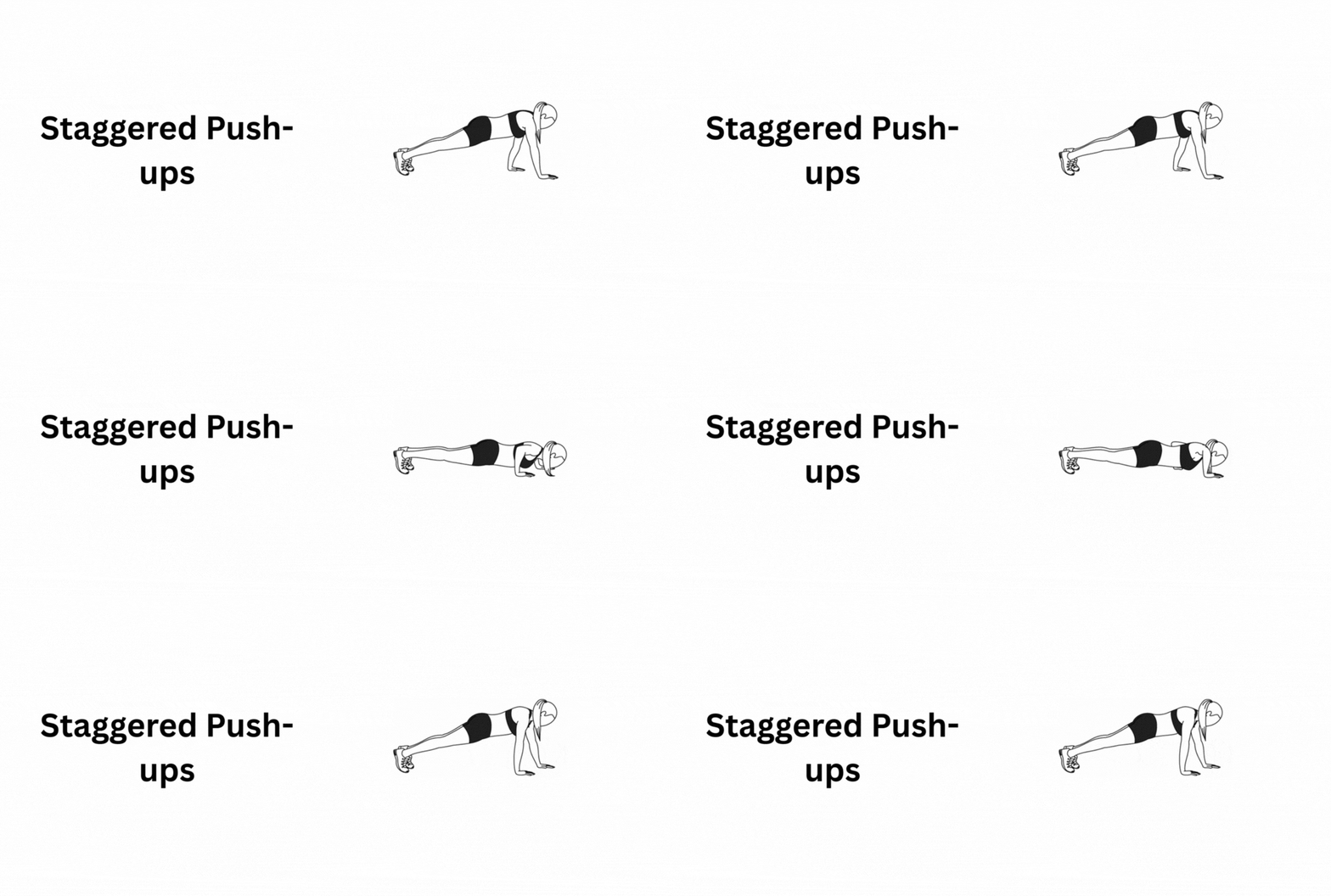
Staggered Push-ups
Introduction
Staggered Push-ups are an advanced push-up variation designed to challenge your upper body strength, core stability, and overall coordination more than the standard push-up ever could. In this exercise, your hands are placed in a staggered positionone slightly forward and one slightly backwhich shifts the load asymmetrically between your arms and forces your core to work harder to keep your body stable.
Compared to traditional push-ups, Staggered Push-ups:
- Increase demand on your chest, shoulders, and triceps.
- Require more core engagement for stability due to the uneven hand placement.
- Improve functional strength, balance, and neuromuscular coordination.
Because of these features, Staggered Push-ups are popular among athletes, fitness enthusiasts, and anyone looking to progress from regular push-ups towards more advanced bodyweight strength training. They are often used in:
- Bodyweight strength training programs
- Athletic conditioning
- Home workouts with minimal equipment
- Functional fitness and calisthenics routines
From a strength training perspective, Staggered Push-ups are a type of single-limb bias exercise, where one side of the body carries more of the load, similar to staggered-stance squats or split squats. This enhances unilateral strength and helps correct muscular imbalances.
Benefits of Staggered Push-ups
1. Enhanced Upper Body Strength and Muscle Building
Staggered Push-ups significantly increase the load on one arm at a time, which places greater tension on your pectorals (chest), anterior deltoids (front shoulders), and triceps than a standard push-up. Because one hand is forward and one is back, the arm closer to your torso often bears more of the load, creating a pseudo–single-arm effect.
According to exercise guides, this variation targets a wider area of the chest than standard push-ups and is considered an advanced progression. It also works the shoulders and arms intensely.
From a muscle-building perspective:
- The increased tension and instability can stimulate hypertrophy (muscle growth), especially in the chest and triceps, when done near fatigue in moderate to high rep ranges.
- Staggered Push-ups also challenge the biceps and forearms as stabilizers more than a symmetrical push-up.
- When performed close to muscular failure, they can provide enough mechanical tension and metabolic stress to support muscle growth, similar to other bodyweight pushing exercises.
Research on push-up training in general has shown that push-ups can induce upper body strength and muscle gains comparable to bench press when effort and volume are matched. Extrapolating from this, Staggered Push-upsbeing harder than standard push-upscan be a potent muscle-building tool in a bodyweight workout.
2. Improved Core Stability and Functional Strength
Staggered Push-ups are often described as a “moveable plank,” because your core must work as hard as your upper body to keep your torso rigid and aligned. With your hands staggered, your body is naturally pulled off-center, requiring extra effort from the abdominals, obliques, and lower back muscles to prevent rotation or sagging.
The uneven hand position increases anti-rotation demands, forcing the core to resist twisting and lateral shifting. This develops functional core strength that transfers well to everyday movements and sports, where the body rarely pushes symmetrically.
- Fitness professionals highlight that Staggered Push-ups recruit multiple joints and muscle groups, making them a functional strength exercise rather than an isolated movement.
- Strong core activation also helps maintain a neutral spinal position, crucial for posture and injury prevention.
In functional training terms, Staggered Push-ups:
- Mimic real-life pushing tasks where one arm may be forward (e.g., bracing a door, pushing someone away, blocking in sports).
- Train your body to generate force while stabilizing your trunk, which is essential for running, throwing, and contact sports.
3. Greater Shoulder Stability and Joint Health
The staggered hand position requires more shoulder stability and rotator cuff engagement than standard push-ups. Because each shoulder is placed in a slightly different position relative to the torso, the stabilizing muscles around the joint must work harder to maintain proper alignment.
Fitness professionals note that this variation increases core, shoulder, and triceps stability, which in turn recruits more strength from the rotator cuff muscles. These small stabilizers (supraspinatus, infraspinatus, teres minor, subscapularis) are critical for keeping the humeral head centered in the shoulder socket during pressing motions.
Benefits for shoulder health include:
- Improved proprioception (joint position awareness) because the joint experiences slightly different angles and loads.
- Better dynamic stability under asymmetrical load.
- Potential reduction in risk of shoulder injuries when combined with proper technique and adequate strength base.
Additionally, because the staggered hand placement changes the pressing angle, it can distribute stress differently across the shoulder structures compared to repetitive standard push-ups, which may be beneficial when programmed intelligently.
4. Increased Core–Glute Integration and Postural Control
Proper Staggered Push-ups require not only a strong core but also active engagement of the gluteus maximus to maintain a neutral spine and prevent hip sagging. Experts emphasize that the glutes serve as a functional support system during this exercise, helping you hold a rigid, efficient posture.
Key points:
- A strong gluteus maximus helps prevent pelvic imbalances that can compromise neutral spinal position.
- Engaging the glutes supports proper alignment from shoulders through hips, reducing stress on the lower back.
- This integrated activation pattern (core + glutes) is the same pattern used in athletic movements requiring power and stability, such as sprinting or jumping.
The neutral spine position is defined as having the top of the shoulders, mid-back, and glutes aligned in a straight line. Maintaining this position during Staggered Push-ups:
- Builds postural endurance.
- Encourages efficient movement mechanics.
- Supports long-term spinal health and reduces compensations that can lead to strain.
5. Better Balance, Coordination, and Athletic Performance
Because Staggered Push-ups place a heavier load on one arm and create asymmetrical forces, they are excellent for improving balance and overall body coordination. This makes them especially valuable for athletes and anyone interested in advanced functional training.
Benefits include:
- Enhanced neuromuscular coordination, as your nervous system must efficiently recruit multiple muscles to stabilize the body under uneven load.
- Improved bilateral strength balance, as the staggered position exposes side-to-side differences in strength and control.
- Increased proficiency in other push-up variations and pressing movements, since the staggered position helps develop strength that carries over to conventional push-ups.
Training resources point out that Staggered Push-ups increase stability and balance in the entire body, not just the arms. This broad training effect can support performance in:
- Combat and contact sports
- Team sports involving pushing, blocking, and rapid direction changes
- Calisthenics progressions toward one-arm push-ups
How to Perform Staggered Push-ups
Equipment Needed
One of the advantages of Staggered Push-ups is that they require no equipmentjust your body weight and floor space. However, a few items can improve comfort and performance:
- Exercise mat or soft surface (optional, for wrist and knee comfort)
- Wrist wraps (optional, if you have sensitive wrists)
- Elevated platform (e.g., step or bench) for easier progressions
- Weight vest (advanced variation for added resistance)
Step-by-Step Instructions
There are two main ways to perform Staggered Push-ups:
- Static staggered position: stay with one hand forward, one back for all reps, then switch sides (easier to control).
- Alternating staggered position: switch hand positions on every rep (more coordination and core challenge).
Below is a detailed breakdown for the static version first, then notes for alternating.
Setup
- Start in a standard push-up position.
Place your hands on the floor, slightly wider than shoulder-width, arms straight, shoulders stacked above wrists. Your legs are extended back, feet together or hip-width apart, weight on the balls of your feet.
- Engage your core and glutes.
Brace your abdominal muscles as if preparing for a light punch, and squeeze your glutes to bring your pelvis into a neutral position. Aim for a straight line from head through shoulders, hips, and heelsthis is your neutral spine.
- Stagger your hands.
From the standard push-up position, move one hand about 6 inches forward and the other about 6 inches back, keeping them roughly shoulder-width apart side-to-side. The forward hand will be closer to head level, and the backward hand closer to ribcage level.
- Distribute your weight.
Shift your body so both hands still share load, but recognize that the lower (back) hand tends to bear more of the pushing demand. Keep shoulders square and avoid rotating your torso.
- Set your neck and gaze.
Keep your head in line with your spine; look slightly ahead of your hands, not straight down or up. This helps maintain neutral alignment.
Execution
- Inhale and lower your body.
Bend your elbows to slowly lower your chest toward the floor. Keep elbows at about a 30–45° angle from your torso (not flared directly out to the sides). Your nose or chest should aim to come close to the ground at the bottom position.
- Maintain a rigid plank.
As you lower, ensure your shoulders, mid-back, and glutes remain in one straight line. Do not let your hips sag or pike up; resist any rotation that tries to pull you toward one side.
- Feel the asymmetrical load.
The arm that is closer to your torso (back hand) will typically feel more load in the chest and triceps, while the forward hand may feel more shoulder and upper chest engagement. Keep both hands firmly pressing into the floor.
- Pause briefly at the bottom.
Stop just before your chest or nose touches the floor. This brief pause (0.5–1 second) increases time under tension and improves control.
- Exhale and push back up.
Drive your hands into the ground, extending your elbows to return to the starting position. Focus on pressing through the entire hand (not just the fingers or heels of the palms) and maintaining core tension.
- Complete all reps, then switch sides.
Perform the desired number of repetitions, then step your hands back to neutral and reverse the stagger (other hand forward/back) to repeat on the opposite side.
Alternating Reps (Dynamic Stagger)
For an advanced coordination challenge:
- After finishing one rep and returning to the top, quickly switch your hand positionsmove the forward hand back and the back hand forwardbefore starting the next rep.
- Maintain control while switching; avoid bouncing or letting hips sway side-to-side excessively.
- This method keeps your core under constant anti-rotation stress and trains rapid hand repositioning.
Repetitions and Sets
Your ideal sets and reps will depend on your fitness level and training goals.
Beginner to Intermediate (just progressing from standard push-ups):
- Start by mastering regular push-ups and, if needed, staggered knee push-ups.
- Example programming:
- 2–3 sets of 6–8 Staggered Push-ups per side
- Or 2–3 sets of 10–12 total alternating reps (5–6 per side)
A professional guide suggests beginners aim for four total sets of 10 reps, two sets per side, once technique is solid.
Intermediate to Advanced (muscle building and strength):
- 3–5 sets of 8–15 reps per side, or 12–20 alternating reps total.
- For strength emphasis: do fewer reps (6–8) but slower tempo and closer to failure.
- For hypertrophy: use 8–15 reps, focusing on controlled movement and short rest intervals (60–90 seconds).
Advanced (high-performance, conditioning):
- 4–6 sets of 15–20+ alternating reps, or
- Add resistance (weight vest, bands) for 6–12 reps per side.
Target 1–3 reps in reserve (finish the set with 1–3 reps left before failure) to balance safety and effectiveness.
Additional Tips for Success
- Prioritize quality over quantity.
Never sacrifice spinal alignment or shoulder control just to get extra reps. Poor form reduces muscle activation and increases injury risk.
- Breathe rhythmically.
Inhale on the way down, exhale sharply as you push up. Proper breathing helps maintain core tension and reduces neck strain.
- Warm up shoulders and wrists.
Use dynamic movements like arm circles, scapular push-ups, and wrist circles before heavy Staggered Push-up sets to prepare the joints.
- Use slow negatives.
Lower yourself in 3–4 seconds, then push up in 1–2 seconds. Slower eccentrics increase strength and muscle-building stimulus without needing extra equipment.
- Gradually increase difficulty.
Start with elevated surfaces (hands on a bench) or knee-based staggered push-ups, then progress to full floor versions as strength improves.
- Maintain neutral wrists if needed.
If you have wrist pain, perform Staggered Push-ups on push-up handles or dumbbells to reduce extension.
Common Mistakes to Avoid
1. Letting Hips Sag or Pike
One of the most frequent errors is allowing the hips to drop toward the floor (lumbar hyperextension) or lift too high (pike position) during the movement. This breaks the “moveable plank” alignment and shifts stress away from your target muscles.
- Sagging hips overload the lower back and reduce core engagement.
- Piking reduces chest and triceps loading and turns the exercise into more of a shoulder-dominant movement.
Fix it:
- Actively engage your glutes and abdominals throughout the set.
- Imagine pulling your ribs toward your pelvis to avoid arching your lower back.
- Maintain the neutral alignment of shoulders–mid-back–glutes described in professional guidelines.
2. Flaring Elbows Too Wide
Some lifters drop into Staggered Push-ups with elbows pointing almost directly out to the sides. This can place extra stress on the shoulders and reduce triceps contribution.
Fix it:
- Keep elbows at roughly a 30–45° angle from your torso.
- Think about “screwing your hands into the floor” by rotating your elbows slightly backward to align the shoulder joint better.
This elbow path protects the shoulder joint and allows more powerful pressing, similar to good bench press mechanics.
3. Losing Shoulder and Scapular Control
Letting the shoulders shrug up toward your ears or the shoulder blades collapse (winging) under load is a common mistake. This is especially problematic in Staggered Push-ups, where one side is under more stress.
Fix it:
- Keep shoulders away from your ears and actively depress and slightly retract the shoulder blades at the top.
- At the bottom, allow controlled scapular movement but avoid collapsing your chest and rounding your upper back excessively.
- Focus on pressing the floor away at the top of each rep to engage serratus anterior and upper back stabilizers.
4. Rushing Through Reps and Losing Control
Because Staggered Push-ups can feel athletic and dynamic, some people rush the movement or switch hand positions too quickly, which can degrade form and increase injury risk.
Fix it:
- Use a consistent tempo: 2–4 seconds down, 1–2 second