Table of Contents
Introduction
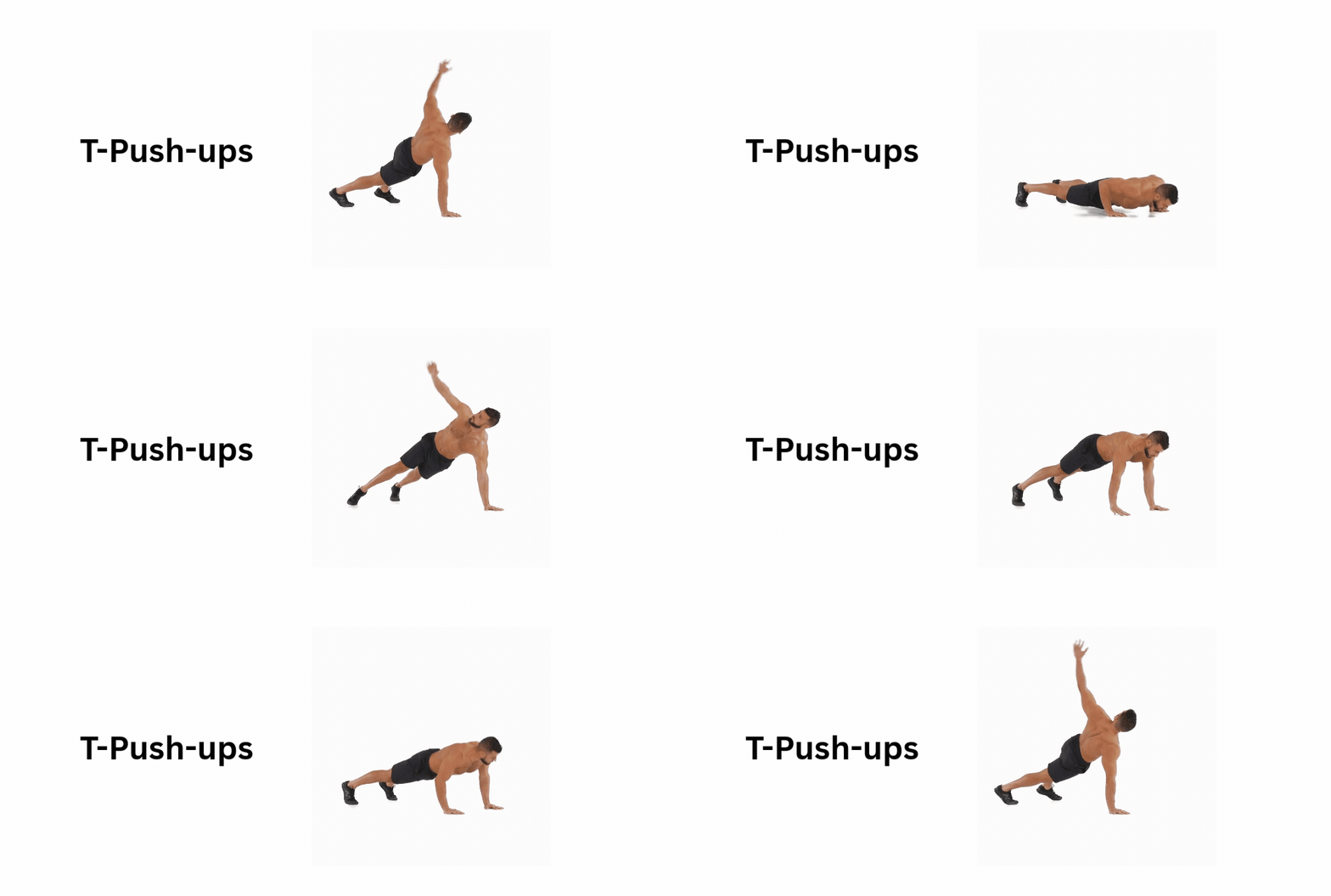
T-Push-ups are a powerful bodyweight exercise that combine a classic push-up with a side plank rotation to form a “T” shape with your body. This hybrid movement makes T-Push-ups far more than a simple chest exercisethey challenge your upper body strength, core stability, balance, and coordination all at once.
Unlike standard push-ups, T-Push-ups require you to rotate your body, support your weight on one arm, and stabilize your hips as you open into a side plank position. This adds a strong unilateral stability and rotational control component that targets your obliques, deep core muscles, and shoulder stabilizers in a functional way. The result is a full-body workout that improves real-world movement patterns, athletic performance, and postural control.
Because T-Push-ups use only your bodyweight and a bit of floor space, they are popular among home exercisers, travelers, and athletes who want an efficient strength training move that can be added to almost any workout: HIIT circuits, core finishers, upper-body days, or full-body sessions. They can be progressed or regressed to match your fitness level, making them useful for both beginners (with modifications) and advanced trainees looking for a challenge.
Benefits of T-Push-ups
T-Push-ups provide all the benefits of traditional push-ups and side planks, plus additional advantages from the rotational and unilateral demands.
1. Full-Body Strength and Muscular Endurance
T-Push-ups are a compound exercise that recruit multiple major muscle groups at once: chest, shoulders, triceps, core, and legs. Like standard push-ups, they train the pectoralis major, anterior deltoids, and triceps, but the side-plank component also demands strong activation from the obliques, transverse abdominis, erector spinae, glutes, and hip stabilizers.
Research on push-ups shows that they effectively build upper-body strength and muscular endurance comparable to bench press at certain intensities, especially when performed close to fatigue. Adding the rotational element increases time under tension and neuromuscular demand, which can further stimulate strength and endurance adaptations in both the upper body and the core.
Because you must support your body in a long lever position while rotating, T-Push-ups also build shoulder and wrist endurance, as well as postural muscles that stabilize your spine. Over time, many people report feeling stronger in pressing movements, planks, and everyday pushing tasks after regularly including T-Push-ups in their routine.
2. Core Stability, Anti-Rotation Strength, and Balance
T-Push-ups significantly improve core stability because your trunk must resist sagging, twisting, or bending while you move from a plank to a side plank. As you rotate, your obliques, transverse abdominis, and erector spinae work together to control movement and prevent excessive rotation. This “anti-rotation” demand is important for spinal health and performance in activities that involve twisting, turning, or changing direction.
Core stability has been linked to better movement efficiency and reduced injury risk, particularly in the lower body. A stable core helps distribute forces across the body and supports proper alignment during sports and daily activities. T-Push-ups challenge your balance and coordination as you shift your weight onto one arm and the edge of your foot, which enhances proprioception (your sense of body position) and control.
Over time, this can translate into:
- Improved balance in single-leg or unilateral exercises
- Better agility and directional changes in sports
- Enhanced posture and trunk control in everyday tasks
3. Shoulder Stability and Injury Prevention Potential
The side-plank phase of T-Push-ups places substantial demand on the shoulder stabilizers, including the deltoids and rotator cuff muscles. You must support much of your bodyweight through a single arm while the shoulder remains stacked over the wrist. This challenges the joint in a functional, closed-chain position that can improve stability.
According to physical therapists, stronger, more stable shoulders are associated with a reduced risk of shoulder injury, especially in people who perform overhead movements such as throwing, serving, or lifting objects overhead. Closed-chain exercises like push-up variations can promote better scapular control and rotator cuff activation, which are key components of shoulder health.
While specific research focuses more on related exercises like the push-up plus for improving serratus anterior function and scapular mechanics, the principles carry over: controlled, full-range push-up patterns with added stabilization demands may contribute to healthier shoulder movement.
4. Functional Strength and Athletic Performance
T-Push-ups build functional strength, meaning strength that transfers to everyday tasks and sports. Many real-life movements involve pushing, bracing, and rotating at the same timethink of opening a heavy door while turning, bracing as you carry a load and pivot, or throwing a ball.
Because T-Push-ups combine:
- Horizontal pushing
- Core stabilization
- Rotation and anti-rotation
- Unilateral loading
they closely mimic these integrated movement patterns. Sports that involve overhead motions (tennis, volleyball, baseball, golf) or rapid changes in direction and trunk rotation can benefit from improved core and shoulder stability as trained by T-Push-ups.
In addition, this exercise enhances coordination between the upper and lower body, as your legs, hips, and shoulders must work together to transition smoothly and maintain a rigid plank line. That integration is essential for powerful, efficient movement in sprinting, jumping, striking, and throwing.
5. Convenience, Versatility, and Minimal Equipment
T-Push-ups are extremely convenient: they require no equipment, minimal space, and can be included in nearly any bodyweight workout. This makes them ideal for:
- Home training with limited gear
- Travel workouts in hotel rooms
- Quick lunch-break fitness sessions
- Outdoor calisthenics routines
Their versatility lies in how easily you can adjust them:
- Make them easier with incline T-Push-ups or modified plank positions
- Make them harder by adding tempo, pauses, or resistance (like a weight vest)
- Insert them into circuits, EMOMs, or AMRAPs for conditioning and muscular endurance
This flexibility supports consistent training, which is one of the most important factors for long-term fitness and muscle building progress.
How to Perform T-Push-ups
Equipment Needed
One of the biggest advantages of T-Push-ups is that they require almost no equipment:
- A flat, non-slip surface (floor, mat, turf)
- Optional: exercise mat for wrist/knee comfort
- Optional: wrist wraps if you have sensitive wrists
That’s it. This makes T-Push-ups an ideal strength training move for minimalist routines.
Step-by-Step Instructions
Setup
- Start in a high plank position.
Place your hands slightly wider than shoulder-width, roughly in line with your mid-chest (about nipple height if you were lying down). Fingers spread, middle fingers pointing forward.
- Align your body.
Extend your legs straight back, feet about hip-width apart or slightly wider for more stability. Your body should form a straight line from head to heelsno sagging hips or piking up.
- Engage your core and glutes.
Lightly brace your abs as if preparing for a gentle punch, and squeeze your glutes. This stabilizes your pelvis and spine during the push-up and rotation.
- Set your shoulders.
Press the floor away to create a slight dome between your shoulder blades (avoid collapsing into your shoulders). Keep your neck neutral and eyes focused slightly ahead of your hands.
Execution
- Inhale and lower into a push-up.
Bend your elbows, keeping them angled about 30–45 degrees from your ribs (not flared out to 90 degrees). Lower your chest toward the floor under control until it’s just above the ground.
- Pause briefly at the bottom.
Maintain a strong plank: ribs down, core tight, glutes engaged. Avoid letting your lower back arch or hips dip.
- Exhale and push back up.
Press through your hands to straighten your arms and return to the high plank position in one smooth motion.
- Rotate into the T position.
At the top of the push-up, shift your weight onto your left hand and the edge of your left foot. Simultaneously:
- Rotate your torso to the right
- Lift your right hand off the ground and reach it toward the ceiling
- Stack your right shoulder above your left shoulder
- Open your chest to the side so your arms form a straight line (a “T” shape) relative to your torso
- Hold briefly.
In the side-plank T position, keep your hips lifted, body in a straight line from head to heels, and shoulders stacked. Your gaze can follow your top hand or remain forward, depending on balance.
- Return to plank.
Bring your right hand back down to the floor under your shoulder, rotate your torso back to the starting plank, and reset your core and shoulder position.
- Repeat to the other side.
Perform another push-up, then rotate onto your right hand and right foot, lifting your left hand toward the ceiling. Continue alternating sides each repetition.
Key form cues:
- Keep your hips level during the rotation; avoid letting the top hip drift too far back.
- Maintain a neutral spineavoid over-arching your lower back.
- Move smoothly and under control, not with jerky or momentum-driven twists.
- Keep the supporting hand under the shoulder in both the plank and side-plank phases.
Repetitions and Sets
Your ideal reps and sets will depend on your current fitness level and training goals:
- Beginners (with good basic push-up form):
- 2–3 sets of 4–6 reps per side (8–12 total reps)
- Rest 60–90 seconds between sets
- Intermediate:
- 3–4 sets of 6–10 reps per side (12–20 total)
- Rest 45–75 seconds
- Advanced:
- 3–5 sets of 8–12 reps per side (16–24 total)
- Rest 30–60 seconds, or integrate into circuits with minimal rest
Because T-Push-ups are demanding, it’s better to perform fewer, higher-quality reps than to push into sloppy, fatigued technique. Aim to stop 1–2 reps before form breaks down.
Additional Tips for Success
- Master regular push-ups first.
Ensure you can perform at least 10–15 solid standard push-ups before progressing to full T-Push-ups; this gives you a strong base of pressing strength and core control.
- Widen your stance for stability.
If you feel wobbly during the rotation, place your feet a little wider. A broader base makes it easier to balance as you move into the T position.
- Use a controlled tempo.
Lower in 2–3 seconds, push up in 1–2 seconds, then rotate in 1–2 seconds. Slower tempos enhance muscle activation and help prevent cheating with momentum.
- Breathe rhythmically.
Inhale as you lower, exhale as you push up and rotate. Avoid holding your breath, which can spike blood pressure during challenging sets.
- Warm up your wrists and shoulders.
Perform gentle wrist circles, shoulder circles, scapular push-ups, and a few standard planks or push-ups before starting T-Push-ups.
- Use progressions and regressions.
If full T-Push-ups are too hard, start with:
- Incline T-Push-ups (hands on a bench or box)
- Push-up with a mini side plank (reduced rotation)
- Kneeling T-Push-ups (knees on the floor to reduce load)
Video
Common Mistakes to Avoid
1. Sagging Hips or Arched Lower Back
One of the most common errors is letting the hips sag and the lower back over-extend during the push-up or rotation. This reduces core activation and increases strain on the lumbar spine.
To fix it:
- Brace your abs and squeeze your glutes before you start each rep.
- Imagine drawing your ribs slightly toward your pelvis.
- If you can’t maintain a straight line from shoulders to heels, regress the exercise (incline or knees).
2. Flaring Elbows Too Wide
Flaring the elbows out at 90 degrees to the body during the push-up phase places excess stress on the shoulder joint and reduces chest engagement.
Instead:
- Keep your elbows angled about 30–45 degrees from your torso.
- Think of “screwing” your hands into the floor slightly (without moving them) to create external rotation at the shoulders and more stable joints.
3. Rushing the Rotation and Using Momentum
Many people swing themselves into the T position with momentum. This bypasses the stabilizing work of the core and shoulders and can cause you to lose balance.
Correct approach:
- Slow down the transition from plank to side plank.
- Control the rotation from your core, not your arm.
- Pause briefly in the T position to reinforce stability and muscle engagement.
4. Misaligned Shoulder and Wrist in the Side Plank
In the T position, your supporting shoulder should be stacked over your wrist. If your hand is too far in front or behind your shoulder, it can strain the joint and reduce stability.
To correct:
- After each rotation, quickly check that your hand is directly under your shoulder.
- Press the floor away, avoiding a “sinking” feeling into the joint.
- Spread your fingers for a wider base and better load distribution.
Muscles Worked in T-Push-ups
Primary Muscle Group
The primary muscles targeted in T-Push-ups are similar to those in a standard push-up:
- Pectoralis major (chest) – main driver of the pressing motion
- Anterior deltoids (front shoulders) – assist in horizontal pushing
- Triceps brachii (back of upper arm) – extend the elbows to push you away from the floor
These muscles perform most of the work in the concentric (pushing up) portion of the exercise and help control the eccentric (lowering) phase.
Secondary Muscles
T-Push-ups heavily recruit secondary stabilizing and core muscles, especially during the side-plank rotation:
- Obliques (internal and external) – control and produce rotation, resist twisting forces
- Transverse abdominis – deep core muscle that stabilizes the spine and pelvis
- Rectus abdominis – assists in maintaining trunk flexion tension in the plank
- Erector spinae – keep the spine extended and stable along its length
- Rotator cuff muscles – stabilize the shoulder joint during load-bearing and rotation
Other Exercises