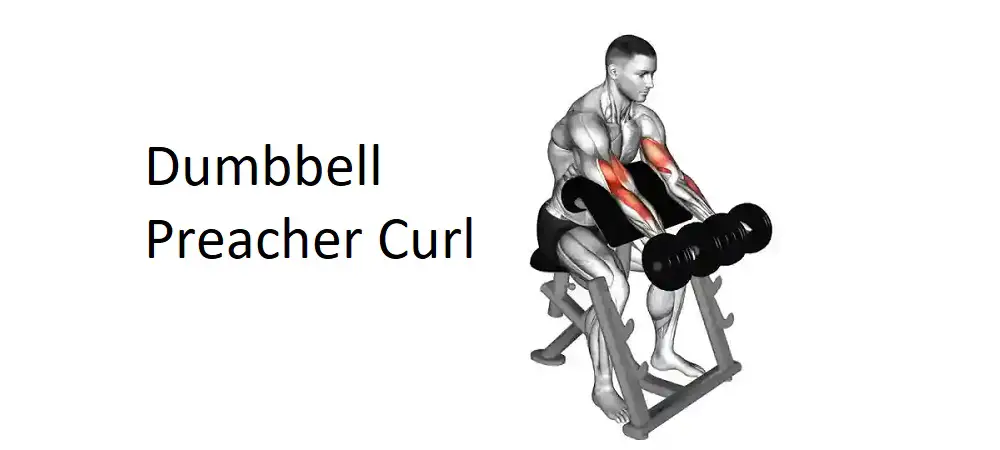
The dumbbell preacher curl is an isolation exercise that trains the muscles responsible for bending your elbow, especially the biceps brachii. By resting your upper arm on an angled pad, you can reduce swinging and focus on moving the dumbbell with controlled elbow flexion.
Unlike a barbell preacher curl, the dumbbell version lets you train one arm at a time and choose the load for each side independently. This can be useful if you notice differences in strength or technique between your arms.
The most important points are to set up securely, keep your upper arm supported, use a comfortable range of motion, and lower the weight under control.
Table of Contents
What Is a Dumbbell Preacher Curl?
A dumbbell preacher curl is a biceps curl performed with your upper arm resting against a preacher bench or a suitable angled support. The supported position makes it more difficult to use your shoulders and body momentum to lift the weight.
You can perform it one arm at a time. Some benches also allow both arms to work at once, provided there is enough room and you can maintain good control.
The exercise is not a complete isolation of the biceps. Other muscles that bend the elbow also contribute to the movement.
Muscles Worked in the Dumbbell Preacher Curl
Biceps brachii
The biceps brachii is the main target. It helps bend the elbow and rotate the forearm so the palm faces upward.
Brachialis
The brachialis lies underneath the biceps and contributes to elbow flexion. It works during preacher curls regardless of whether your forearm is fully turned palm-up.
Brachioradialis and forearm muscles
The brachioradialis assists with bending the elbow. The forearm muscles also help maintain your grip and stabilize your wrist while you move the dumbbell.
The preacher position changes the shoulder and upper-arm position compared with a standing curl. Research comparing different dumbbell curl positions has found differences in biceps activity across the range of motion, but it does not establish that one variation is best for every lifter or guarantees greater muscle growth. You can read the published study comparing dumbbell curl positions.
Benefits of Dumbbell Preacher Curls
More controlled biceps training
The pad supports your upper arm and makes it harder to swing the weight using your torso. This helps you focus on the elbow movement.
Independent work for each arm
Using one dumbbell at a time lets you select an appropriate load for each side and pay attention to differences in technique.
Easier technique feedback
You can notice when your upper arm lifts off the pad, your wrist bends, or the weight becomes too heavy to control.
A useful addition to an arm workout
Preacher curls can complement standing curls, hammer curls, and other pulling exercises. They provide a different arm position rather than replacing every other biceps exercise.
The benefits depend on consistent training, suitable resistance, recovery, and gradually improving performance. The exercise does not guarantee a particular arm shape or prevent injury.
How to Do a Dumbbell Preacher Curl With Proper Form
Step 1: Set up the bench
Adjust the preacher bench so that your upper arm rests comfortably on the pad and your body is stable. Keep your feet planted on the floor.
If you use an adjustable bench as an alternative, make sure it is locked securely and that the support will not slip while you exercise.
Step 2: Hold the dumbbell
Grip one dumbbell with your palm facing upward. Rest the back of your upper arm against the angled pad and keep your wrist aligned with your forearm.
Start with a weight you can control without lifting your elbow off the pad.
Step 3: Lower to a comfortable starting position
Allow your elbow to straighten gradually until you reach a comfortable, controlled position. You do not need to force a hard lockout or stretch farther than your elbow comfortably allows.
Avoid bouncing or abruptly reversing direction at the bottom.
Step 4: Curl the dumbbell upward
Bend your elbow to lift the dumbbell toward your shoulder. Keep your upper arm supported instead of lifting your elbow or moving your shoulder to finish the repetition.
Move smoothly rather than trying to lift the weight as quickly as possible.
Step 5: Pause briefly at the top
At the top of the curl, contract your biceps without shrugging or twisting your torso. Keep your wrist comfortable and avoid forcing the dumbbell into an exaggerated position.
Step 6: Lower under control
Return the dumbbell to the starting position slowly enough to maintain control. Do not let gravity drop the weight.
Finish your repetitions, then switch arms if you are using the single-arm version. Use the same range of motion and technique on both sides.
Common Dumbbell Preacher Curl Mistakes
Using too much weight
If the dumbbell is too heavy, you may lift your elbow, twist your body, or shorten the movement.
How to fix it: Reduce the load until you can perform smooth repetitions while keeping your upper arm supported.
Bouncing at the bottom
A sudden reversal from the lowest position can make the movement harder to control.
How to fix it: Lower gradually and change direction smoothly. Do not force your elbow into a hard lockout.
Lifting the upper arm off the pad
This changes the movement and allows more shoulder involvement.
How to fix it: Keep the upper arm in contact with the pad. If you cannot do this, use a lighter dumbbell.
Bending the wrist
Allowing the wrist to fold backward or forward can make the grip less comfortable and less stable.
How to fix it: Keep your wrist in a natural, straight position and avoid gripping harder than necessary.
Dropping the dumbbell during the lowering phase
Letting the weight fall removes control over part of the repetition.
How to fix it: Lower the dumbbell deliberately. Reduce the weight if you cannot control the descent.
Using different technique on each arm
It is common for one side to be stronger or more coordinated than the other.
How to fix it: Start with the side that feels less capable, then match its clean repetitions on the other side. Do not force the weaker arm to match a load it cannot control.
Sets, Reps, and Training Tips
The right number of sets and repetitions depends on your experience, goals, and the rest of your training program. For general muscle-building training, a practical starting point is:
- Sets: 2 to 4 working sets per arm.
- Repetitions: 8 to 15 controlled repetitions per set.
- Rest: About 60 to 120 seconds between sets, or longer if you need more recovery to maintain good form.
- Effort: Finish most sets with a small number of good repetitions still possible.
These are starting guidelines, not fixed rules for everyone.
How to progress
Choose a weight that allows you to complete your target repetitions without swinging or losing control. As you become able to complete the top of your chosen repetition range with consistent form, increase the weight by a small amount if available.
Do not increase the load just because you can move a heavier dumbbell through a shorter range. Consistent technique is more useful than forcing extra weight.
Preacher curls are generally an accessory exercise. Many people place them after larger pulling movements such as rows or pulldowns so that arm fatigue does not interfere with those exercises.
Dumbbell Preacher Curl Variations
Single-arm dumbbell preacher curl
This is the standard version for training one side at a time. It lets you concentrate on each arm and select the load independently.
Alternating preacher curl
If your bench setup allows it, alternate between arms while keeping the working upper arm supported. Avoid twisting your torso or shifting your weight to help complete a repetition.
Neutral-grip preacher curl
Hold the dumbbell with your palm facing inward if the setup allows a comfortable grip. This changes how the elbow-flexor muscles contribute to the movement, including the brachialis and brachioradialis.
Barbell preacher curl
The barbell preacher curl trains both arms with a bar. It can be more time-efficient, while the dumbbell version makes it easier to train each arm independently.
Choose the variation that lets you maintain a comfortable grip and controlled movement.
Dumbbell Preacher Curl vs. Barbell Preacher Curl
Both exercises use a preacher pad to support the upper arms. The main difference is the equipment and how each arm handles the load.
- Dumbbell preacher curl: Lets you train each arm separately and select the weight independently.
- Barbell preacher curl: Lets both arms lift a shared load and may make it quicker to complete a set.
Neither version is automatically better for everyone. Your choice can depend on your equipment, wrist comfort, training goals, and ability to maintain good form.
Dumbbell Preacher Curl Alternatives
If you do not have a preacher bench or the movement does not feel comfortable, consider these options.
Standing dumbbell curl
This is a straightforward biceps exercise that requires only dumbbells. Keep your torso still and avoid swinging the weights.
Hammer curl
A hammer curl uses a neutral grip, with your palms facing each other. It trains the elbow flexors, including the brachialis and brachioradialis.
Incline dumbbell curl
The incline dumbbell curl uses a different shoulder position while your arms hang beside your body. It can complement preacher curls in a varied arm routine.
Dumbbell spider curl
The dumbbell spider curl uses a chest-supported position to reduce body movement while you curl.
Machine bicep curl
A machine bicep curl can provide a more guided movement path. Adjust the machine so it fits your body and allows comfortable elbow movement.
Choose an alternative that you can perform safely and consistently. You do not need to use every variation in the same workout.
Safety Tips
Start with a light dumbbell while learning the movement. Make sure the bench or support is secure, keep your wrist comfortable, and lower the weight under control.
Do not bounce at the bottom, force a hard lockout, or continue through sharp pain. Stop if you experience unusual elbow, wrist, or shoulder discomfort. If the symptoms persist, consult an appropriately qualified healthcare professional.
If you have a current elbow, wrist, or shoulder injury, seek individual guidance before adding preacher curls to your routine.
Frequently Asked Questions
What muscles do dumbbell preacher curls work?
They primarily train the biceps brachii, with help from the brachialis and brachioradialis. The forearm muscles help stabilize your grip and wrist.
Are dumbbell preacher curls good for beginners?
They can be suitable for beginners who can set up the bench securely and control the dumbbell. Start light and focus on keeping your upper arm supported.
How many sets and reps should I do?
A practical starting point for general muscle-building training is 2 to 4 sets of 8 to 15 controlled repetitions per arm. Adjust this to your experience and overall training volume.
Should I fully straighten my elbow at the bottom?
Lower the dumbbell to a comfortable position that you can control. Do not force a hard lockout, bounce at the bottom, or continue if the position causes pain.
Can dumbbell preacher curls help with arm strength differences?
Training each arm separately makes it easier to notice differences in strength and technique. Use the same controlled technique on both sides and match the repetitions to what the less capable side can perform safely.
Are dumbbell preacher curls better than regular curls?
Neither is universally better. Preacher curls support the upper arm and discourage swinging, while standing curls allow a different arm position and require more control of the torso.
What can I do if I do not have a preacher bench?
You can try standing dumbbell curls, hammer curls, incline dumbbell curls, or other curl variations. Avoid makeshift supports that could slip or make the exercise unstable.
Final Thoughts
Dumbbell preacher curls are a useful option for focused biceps training. Set up securely, keep your upper arm supported, and use a range of motion you can control without pain.
Choose a manageable weight and progress gradually. As part of a balanced arm routine, preacher curls can complement other curl variations without needing to replace them.