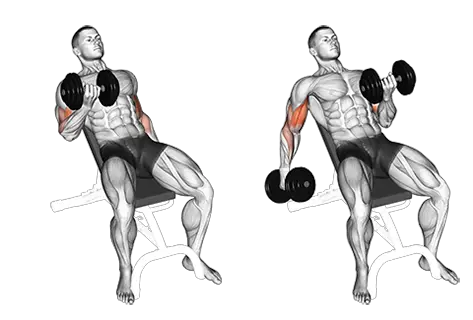
The alternate incline dumbbell curl is an isolation exercise that trains the biceps by curling one dumbbell at a time while seated against an inclined bench. Unlike a standing curl, this variation places the upper arms slightly behind the torso at the starting position, changing the length and mechanics of the biceps during the movement.
This exercise is useful for lifters who want to train each arm independently, practice controlled repetitions, and add variety to a biceps workout. However, the incline position can make the exercise feel more challenging than a standing curl, so choosing the right weight and maintaining consistent technique are essential.
In this guide, you will learn how to perform the alternate incline dumbbell curl, which muscles it works, how to set up the bench, which mistakes to avoid, and how to include it in a balanced training program.
Table of Contents
What Is the Alternate Incline Dumbbell Curl?
The alternate incline dumbbell curl is a dumbbell biceps exercise performed while sitting against an inclined bench. You hold a dumbbell in each hand, curl one arm, lower that weight under control, and then repeat with the opposite arm.
The incline position allows your upper arms to hang behind your torso rather than directly alongside it. Because the biceps crosses both the shoulder and elbow joints, this shoulder position changes the muscle’s length at the beginning of the curl.
The exercise primarily involves elbow flexion, with the biceps also contributing to forearm supination, or turning the palm upward. The brachialis and brachioradialis assist with elbow flexion.
Unlike a standing curl, the bench supports your back and makes it easier to notice excessive torso movement. It does not eliminate cheating automatically, however: moving the shoulders, swinging the dumbbells, or using excessive weight can still compromise your technique.
Quick exercise overview
- Exercise type: Isolation exercise
- Primary muscle: Biceps brachii
- Supporting muscles: Brachialis and brachioradialis
- Equipment: Incline bench and two dumbbells
- Movement pattern: Alternating elbow flexion
- Typical training use: Biceps accessory exercise
- Experience level: Suitable for beginners who can maintain a comfortable position and control light dumbbells
Muscles Worked in the Alternate Incline Dumbbell Curl
The exercise primarily trains the elbow flexors. The exact contribution of each muscle depends on your grip, shoulder position, range of motion, and resistance.
1. Biceps Brachii
The biceps brachii is the main target muscle. It has two heads—the long head and short head—and contributes to both elbow flexion and forearm supination.
During an incline curl, the upper arm begins behind the torso. This position lengthens the biceps at the shoulder compared with a conventional standing curl, changing the demands placed on the muscle throughout the repetition.
Both heads contribute to the movement. It is not accurate to say that the incline curl completely isolates one head or guarantees a more pronounced biceps peak.
2. Brachialis
The brachialis lies underneath the biceps and assists with bending the elbow. It contributes to elbow-flexion strength regardless of whether the palm faces upward or remains in a neutral position.
Developing the brachialis can contribute to overall upper-arm thickness alongside training the biceps brachii.
3. Brachioradialis
The brachioradialis is a forearm muscle that assists with elbow flexion. It also helps control the movement as the dumbbell travels upward and downward.
Although the incline curl is primarily a biceps exercise, the forearm muscles help maintain grip and control the weights.
4. Supporting Muscles
Muscles around the shoulder and torso help maintain your position against the bench. The wrist muscles also help keep the dumbbells stable.
These supporting muscles contribute to control, but they are not the main reason to include the exercise in a workout.
How to Set Up the Incline Bench
A stable setup makes it easier to perform the exercise with consistent technique.
Choose a Comfortable Bench Angle
An incline of approximately 45–60 degrees is a practical starting point. The ideal angle depends on your shoulder comfort, mobility, and ability to let your arms hang naturally.
A steeper bench changes the shoulder position, so avoid choosing an angle simply because it is recommended for someone else.
Select the Right Dumbbells
Choose weights that allow you to curl without swinging your torso or moving your elbows excessively. Incline curls may require lighter dumbbells than standing curls because your body position makes it harder to compensate with momentum.
Establish a Stable Position
Sit back against the pad, keep both feet flat on the floor, and allow your arms to hang beside your torso. Keep your shoulders relaxed and your wrists aligned with your forearms.
If the bench causes shoulder discomfort or prevents you from controlling the starting position, adjust the angle or use another curl variation.
How to Perform the Alternate Incline Dumbbell Curl
Follow these steps to perform each repetition with control.
Step 1: Sit on the Incline Bench
Adjust the bench to a comfortable angle and sit with your back supported. Hold one dumbbell in each hand, allowing your arms to hang naturally beside your torso.
Keep both feet firmly planted on the floor and your head in a comfortable, neutral position.
Step 2: Position Your Arms
Start with your elbows extended comfortably and positioned slightly behind your torso. Your palms can face forward or turn slightly inward, depending on your preferred starting grip.
Avoid forcing your shoulders backward into an uncomfortable stretch. The goal is a controlled starting position, not the greatest possible stretch.
Step 3: Curl One Dumbbell
Bend one elbow to raise the dumbbell toward the same-side shoulder. As the weight rises, rotate your forearm so your palm turns upward if that motion feels comfortable.
Keep your upper arm relatively still. The forearm should perform most of the visible movement rather than the shoulder swinging forward to help lift the weight.
Step 4: Control the Top Position
At the top, pause briefly and contract the biceps. Do not shrug your shoulder, bend your wrist excessively, or force the dumbbell against your shoulder.
The weight only needs to travel through the range of motion you can control without discomfort.
Step 5: Lower the Dumbbell Slowly
Lower the weight under control to the starting position. Avoid dropping it quickly or allowing gravity to dictate the movement.
Return the arm to a comfortable extended position before beginning the next repetition.
Step 6: Alternate Arms
Once the first dumbbell has returned to the starting position, curl the opposite arm using the same technique.
Continue alternating between arms. Keep your back supported, shoulders controlled, and feet planted throughout the set.
Coaching cue: Curl smoothly, keep the upper arm relatively still, and lower each dumbbell under control. If you must swing your body to complete the repetition, reduce the weight.
Benefits of the Alternate Incline Dumbbell Curl
1. Trains the Biceps Directly
The exercise focuses on elbow flexion and can provide useful direct work for the biceps as part of a resistance-training program.
2. Allows Independent Arm Training
Each arm performs its own repetition. This makes it easier to pay attention to differences in control, range of motion, and strength between sides.
Start with the same number of repetitions on each side, using a load that both arms can handle with good technique.
3. Changes the Shoulder Position
The incline places the upper arms behind the torso, changing the starting length of the biceps compared with standing curls.
This provides a different training stimulus, but it does not guarantee superior results for every lifter or make other curl variations unnecessary.
4. Makes Excessive Torso Movement Easier to Notice
Because your back rests against the bench, large movements of the torso are easier to identify. You must still control your shoulders and elbows, however.
5. Adds Variety to a Biceps Program
The alternate incline dumbbell curl can complement standing dumbbell curls, barbell curls, hammer curls, and other elbow-flexion exercises.
Exercise variety is most useful when it serves a purpose in your program rather than replacing consistent training and gradual progression.
What Does Research Say About Incline Dumbbell Curls?
Research can help explain how curl variations differ, but it is important to distinguish muscle activation from long-term muscle growth.
A study published in the Journal of Electromyography and Kinesiology compared the incline dumbbell curl, standard dumbbell curl, and dumbbell preacher curl in 22 participants. The researchers measured electrical activity in the long head of the biceps during controlled repetitions.
The incline curl and standard dumbbell curl showed similar overall activation patterns across the range of motion, while the preacher curl showed a different pattern across elbow angles. The study examined acute muscle activity; it did not establish that the incline curl produces more muscle growth over time.
Read the peer-reviewed study on shoulder position and biceps activation for its methods and findings.
A later randomized trial comparing incline and preacher curls over eight weeks reported different regional changes in elbow-flexor muscle thickness between the two exercise groups. The findings suggest that exercise selection may influence adaptations, but they do not prove that one curl is universally superior for everyone.
See the research comparing muscle growth and strength after preacher and incline curls.
Practical takeaway: The incline curl is a useful option for training the biceps, but consistent training, appropriate resistance, sufficient effort, recovery, and progressive overload matter more than relying on a single exercise to deliver special results.
Common Mistakes and How to Fix Them
Using Too Much Weight
Heavy dumbbells can encourage swinging, shortened repetitions, and unwanted shoulder movement.
Fix: Reduce the weight until you can curl and lower the dumbbell smoothly without changing your body position.
Moving the Elbows Forward
Allowing the upper arms to move substantially forward changes the movement and can increase shoulder involvement.
Fix: Keep your upper arms relatively still and avoid bringing your elbows forward just to lift the weight higher.
Swinging the Torso
Rocking from side to side makes the repetition less controlled and can place unnecessary stress on the shoulder and elbow.
Fix: Keep your back against the bench and both feet firmly planted. If you cannot do this, use lighter dumbbells.
Rushing the Lowering Phase
Dropping the dumbbell quickly reduces control over the eccentric portion of the movement.
Fix: Lower the weight deliberately, taking roughly two to three seconds if that tempo helps you maintain control. This timing is a practical cue, not a mandatory rule.
Bending the Wrists
Excessively curling the wrist can make the movement less comfortable and interfere with stable dumbbell control.
Fix: Keep the wrist aligned with the forearm and focus on bending the elbow.
Choosing an Uncomfortable Bench Angle
An unsuitable angle can make it difficult to position the arms naturally or may cause shoulder discomfort.
Fix: Adjust the bench until your arms hang comfortably. If discomfort persists, choose a different exercise rather than forcing the position.
Cutting the Range of Motion Short
Using a partial repetition simply to handle more weight can reduce the intended movement range.
Fix: Use a load that lets you lower the dumbbell to a comfortable extended position and curl through a controlled range without pain.
Sets, Reps, and Progression
Your sets and repetitions should reflect your experience, goals, and the rest of your training program.
For General Muscle Growth
A practical starting point for many lifters is:
- Sets: 2–3
- Repetitions: 8–15 per arm
- Rest: About 60–120 seconds between sets, adjusted to recovery
- Effort: Finish each set with a small number of technically sound repetitions still possible
These are starting guidelines, not scientifically fixed requirements. You may need fewer sets if your biceps already receive substantial work from rows, pulldowns, chin-ups, or other curls.
How to Progress
Use a simple progression method:
- Choose a weight you can control for your planned repetitions.
- Keep the same bench angle and technique across sessions.
- Gradually increase repetitions while maintaining good form.
- Once you can reach the top of your target range for all sets with consistent technique, consider increasing the dumbbell weight slightly.
- Reduce the load again if the increase causes swinging, discomfort, or shortened repetitions.
Progression does not require increasing weight every workout. Consistent, well-controlled training is more useful than forcing increases before you are ready.
Where Should It Fit in a Workout?
The alternate incline dumbbell curl is generally an accessory exercise. It can fit after larger pulling movements or alongside other direct arm exercises.
For example:
- A rowing or pulldown exercise
- A standard dumbbell or barbell curl
- Alternate incline dumbbell curls
- A hammer curl variation, if appropriate for your program
You do not need to perform every curl variation in the same session. Choose a manageable amount of work that you can recover from and progress over time.
Variations and Alternatives
Different curl variations change the grip, shoulder position, or stability requirements. Choose one based on your goals, equipment, and comfort.
Standard Dumbbell Curl
The standard dumbbell curl is performed standing or seated, with the upper arms beside the torso. It is a useful alternative if the incline position is uncomfortable.
See SaveDollar’s Dumbbell Curl guide for setup, technique, common mistakes, and related variations.
Barbell Curl
The barbell curl allows both arms to work together using a fixed bar. It can be useful when you prefer a bilateral curl and want to track load progression.
Read SaveDollar’s Barbell Curl guide for technique and programming advice.
EZ-Bar Curl
An EZ-bar curl uses an angled grip that some lifters find more comfortable for their wrists. Comfort varies, so choose the grip that lets you perform the movement without pain.
See SaveDollar’s EZ-Bar Curl guide.
Barbell Preacher Curl
The preacher curl supports the upper arms on a pad, changing the mechanics and stability of the exercise. It is another option for direct elbow-flexion training.
Read SaveDollar’s Barbell Preacher Curl guide for setup and technique.
Drag Curl
The drag curl uses a different bar path, with the weight travelling close to the torso as the elbows move slightly behind or alongside the body.
See SaveDollar’s Drag Curl guide for its technique and differences from conventional curls.
Safety Tips
- Start with a manageable load and learn the movement before progressing.
- Keep both feet planted and your back supported.
- Use a comfortable bench angle that allows your arms to hang naturally.
- Avoid forcing a deep stretch or pushing through shoulder, elbow, or wrist pain.
- Keep the dumbbells under control when raising and lowering them.
- Stop if you experience sharp pain, numbness, or unusual symptoms.
If you have a current shoulder, elbow, or wrist injury, seek individualized advice from a qualified healthcare professional before performing the exercise.
Frequently Asked Questions
What muscles does the alternate incline dumbbell curl work?
It primarily works the biceps brachii, with assistance from the brachialis and brachioradialis. The forearm and shoulder muscles also help control the dumbbells and maintain position.
Is the alternate incline dumbbell curl good for beginners?
It can be suitable for beginners who can maintain a comfortable position and control light dumbbells. Start with conservative resistance, learn the technique, and progress gradually.
What bench angle should I use?
Around 45–60 degrees is a practical starting range for many people. Adjust the bench to your comfort and mobility rather than forcing a specific angle.
Should I rotate my palms while curling?
You may rotate the forearm so the palm faces upward during the curl if that motion is comfortable. Keep your wrists controlled and avoid forcing the rotation if it causes discomfort.
Is the incline curl better than the standing dumbbell curl?
Neither is universally better. The incline curl changes the shoulder position and provides back support, while a standing curl allows a more upright arm position. Both can be useful in a balanced program.
How many sets and reps should I perform?
A practical starting point is 2–3 sets of 8–15 repetitions per arm. Adjust the volume according to your experience, other biceps exercises, and recovery.
Can the incline curl build bigger biceps?
It can contribute to biceps growth when included in a suitable resistance-training program. Results depend on consistent training, effort, progressive overload, nutrition, and recovery; the exercise alone cannot guarantee a particular result.
Why do incline curls feel harder than standing curls?
The upper arms start behind the torso, changing the length and leverage of the biceps during the movement. The position can also make it harder to use body momentum. As a result, you may need lighter dumbbells than you use for standing curls.
Should I perform both arms at the same time or alternate?
Both approaches can work. The alternating version lets you focus on one arm at a time, while simultaneous curls let both arms perform each repetition together. Choose the version that allows consistent technique and fits your program.
Conclusion
The alternate incline dumbbell curl is a useful exercise for direct biceps training. By placing the upper arms behind the torso and curling one dumbbell at a time, it provides a different movement pattern from a standard standing curl.
Use a comfortable bench angle, choose weights you can control, keep your upper arms relatively still, and lower each repetition deliberately. Combine the exercise with a balanced training program and progress gradually rather than chasing heavier weights at the expense of technique.
The most effective curl variation is one that suits your body, supports your training goals, and allows you to train consistently with good form.