Calf exercises help strengthen the muscles at the back of your lower legs, which contribute to walking, running, jumping, and controlling ankle movement. Whether you train at a gym or at home, choosing suitable calf exercises can help you develop lower-leg strength and build a more balanced workout routine.
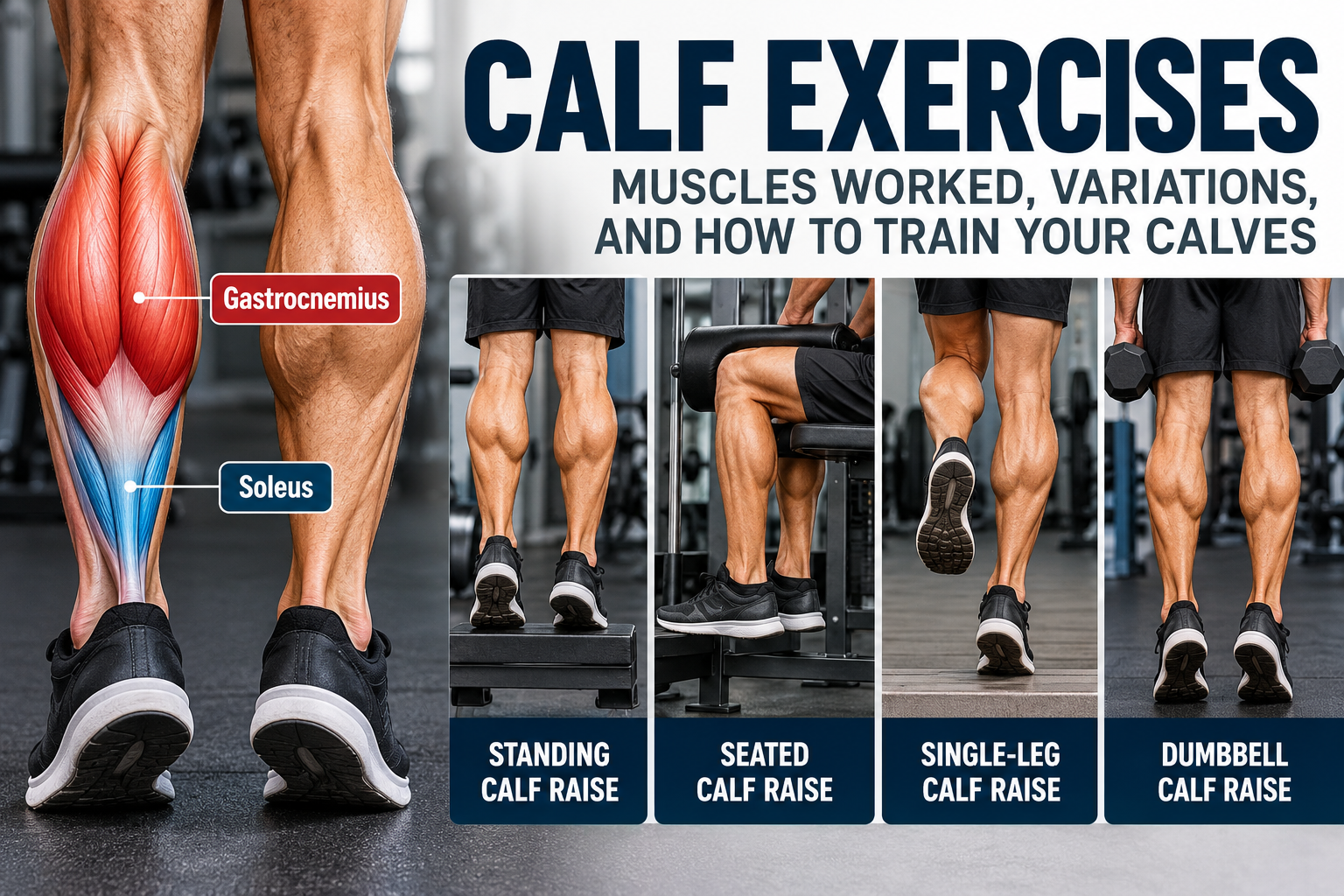
The two main calf muscles are the gastrocnemius and soleus. Standing calf raises train both muscles, with greater emphasis on the gastrocnemius when the knee is relatively straight. Seated calf raises change the knee position and can shift the emphasis toward the soleus.
This guide explains the main calf muscles, compares common calf exercise variations, and covers practical ways to train your calves with good technique.
Table of Contents
What Muscles Do Calf Exercises Work?
The calf muscles work together to point the foot downward and help raise the heel. Their contribution changes depending on your knee position, the exercise variation, and the movement being performed.
Gastrocnemius
The gastrocnemius is the prominent, two-headed muscle that forms much of the visible shape of the calf. It crosses both the knee and ankle joints.
It contributes to plantar flexion, the movement of pointing your toes downward, and also assists with knee flexion. Standing calf raises are a common way to train this muscle because the knee remains relatively straight.
For additional anatomical detail, see the NCBI Bookshelf reference on the gastrocnemius muscle
Soleus
The soleus lies underneath the gastrocnemius. It contributes to plantar flexion and plays an important role in supporting the body during standing and walking.
Because the soleus does not cross the knee joint, it remains active when the knee is bent. Seated calf raises are one way to train it, although no common calf-raise variation completely isolates a single muscle.
Other muscles involved in ankle movement
Smaller muscles in the lower leg and foot also contribute to ankle movement, foot control, and stability. Their involvement varies with the exercise and the direction of movement.
For general calf training, standing and seated calf raises are practical starting points because they allow you to train plantar flexion in different knee positions.
Best Calf Exercises
The best variation for you depends on your equipment, training experience, comfort, and goals. Start with a version you can perform under control and progress gradually.
1. Standing Calf Raise
Standing calf raises are a straightforward way to train the calf muscles. You can perform them using body weight, dumbbells, a dedicated calf machine, or a stable raised surface.
How to perform standing calf raises
- Stand upright with your feet approximately hip-width apart.
- Hold a stable support for balance if needed.
- Keep your knees relatively straight without forcing them into a locked position.
- Raise your heels by pressing through the balls of your feet.
- Pause briefly at the top without bouncing.
- Lower your heels slowly and repeat.
Technique tips
- Use a comfortable range of motion.
- Keep your ankles aligned rather than rolling excessively toward the inside or outside of your feet.
- Avoid using momentum to lift your heels.
- Increase resistance only when you can maintain control throughout the movement.
Standing calf raises are a useful starting point for people who want to train their calves without requiring a specialized machine.
2. Seated Calf Raise
Seated calf raises are performed while sitting on a bench, chair, or dedicated machine. Resistance may come from a machine, a weight plate, or a dumbbell placed securely over the thighs.
How to perform seated calf raises
- Sit upright with your feet flat on the floor or on a stable foot platform.
- Position your knees comfortably, usually bent to approximately a right angle.
- If using resistance, make sure the weight is secure and comfortable.
- Raise your heels while keeping the balls of your feet supported.
- Pause briefly at the top.
- Lower your heels under control and repeat.
Technique tips
- Keep your feet stable throughout the movement.
- Avoid bouncing at the bottom or rushing through repetitions.
- Use a resistance level that allows you to move your heels through a controlled range.
- Adjust the setup if the weight presses uncomfortably against your thighs.
Seated calf raises can complement standing variations by training the calves with the knees bent. They are particularly useful when you want to include more than one knee position in your calf-training routine.
3. Single-Leg Calf Raise
Single-leg calf raises train one side at a time. They can be useful for challenging each leg individually and making bodyweight training more demanding.
How to perform single-leg calf raises
- Stand near a wall, rail, or other stable support.
- Shift your weight onto one foot and lift the other foot slightly from the floor.
- Keep your working foot aligned and your body upright.
- Raise your heel as high as you can without losing control.
- Lower slowly to the starting position.
- Complete your planned repetitions, then switch legs.
Start on level ground if balance is difficult. Once you can perform the movement comfortably, you can consider adding resistance or using a stable step for a greater range of motion.
4. Dumbbell Calf Raise
Dumbbell calf raises allow you to add resistance without using a dedicated calf machine.
How to perform dumbbell calf raises
- Stand upright with a dumbbell in one or both hands.
- Position your feet comfortably and keep your body balanced.
- Raise your heels while maintaining control of the dumbbells.
- Pause briefly at the top.
- Lower slowly and repeat.
Use a stable stance and avoid swinging the weights. If holding dumbbells makes balancing difficult, begin with bodyweight calf raises and add resistance when your technique is consistent.
5. Calf Press on a Leg Press Machine
A calf press uses the leg press machine to train plantar flexion rather than performing a full leg-press repetition. It can be an option for people who prefer machine-based resistance.
Read the SaveDollar Leg Press guide for information about the machine and its setup.
Before performing a calf press, make sure you understand the machine’s safety mechanism and can keep your feet securely supported. Use a conservative load, move through your ankles rather than repeatedly bending your knees, and follow the machine’s instructions. Do not position your feet where they could slip off the platform.
Standing vs. Seated Calf Raises
Both variations train the calves, but the position of your knee changes the relative contribution of the muscles.
| Feature | Standing calf raise | Seated calf raise |
|---|---|---|
| Knee position | Relatively straight | Bent |
| Main calf muscles | Gastrocnemius and soleus | Soleus and gastrocnemius |
| Equipment | Body weight, dumbbells, or a machine | Chair, weights, or a seated machine |
| Useful for | General calf strength and training with a straight knee | Adding bent-knee calf training |
| Main technique priority | Keep the body stable and control the heel movement | Keep the feet stable and control the resistance |
Research comparing standing and seated calf-raise training found greater gastrocnemius muscle growth with standing calf raises in one 12-week study of 14 untrained adults. Soleus growth was similar between the two groups. These findings are useful, but the study was small, so they should not be taken as proof that standing calf raises are always better for everyone. Read the research comparing standing and seated calf-raise training.
Neither variation completely isolates one calf muscle. Both muscles contribute to ankle plantar flexion, and their relative contribution depends on the exercise setup and movement.
If your goal is general calf development, you can include both variations when they suit your equipment and training routine.
How to Choose Calf Exercises for Your Goals
You do not need every available calf exercise in the same workout. Choose variations that fit your current ability and the equipment you have.
For beginners
Start with standing calf raises using body weight and a stable support if necessary. Focus on a comfortable range of motion and controlled repetitions before adding resistance.
For home workouts
Bodyweight standing calf raises and supported single-leg calf raises require little or no equipment. A stable step may provide a greater range of motion, but only use one if it is secure and suitable for the movement.
For gym training
A gym routine can include standing calf raises, seated calf raises, dumbbell variations, or calf presses on a suitable machine. Select options that allow you to train consistently without compromising technique.
For balanced calf training
Consider including both straight-knee and bent-knee variations over your training week. This gives you more than one way to load the calf muscles without needing a long list of different exercises.
Sets, Repetitions, and Progression
The appropriate training volume depends on your experience, current routine, recovery, and how challenging each set feels. There is no single repetition range that is best for everyone.
A practical way to begin is to choose one calf exercise and perform a manageable number of controlled sets. Select a resistance that allows you to complete the repetitions without bouncing or shortening the movement to lift a heavier weight.
As the exercise becomes easier, you can progress gradually by:
- Adding repetitions while maintaining good technique.
- Increasing resistance in small increments.
- Using a more challenging variation when appropriate.
- Tracking your performance to see whether you are improving over time.
Avoid increasing the weight and total training volume sharply at the same time. Your calves and Achilles tendons need time to adapt to increases in training stress.
Common Calf Training Mistakes
Bouncing through repetitions
Using momentum can make the exercise less controlled. Raise and lower your heels deliberately, and avoid relying on a quick bounce to complete each repetition.
Using too much weight
If the resistance prevents you from moving your heels through a comfortable range, reduce the load. Consistent technique is more useful than lifting a weight you cannot control.
Neglecting the lowering phase
Lower your heels under control rather than allowing them to drop suddenly. Choose a range of motion that feels manageable and does not cause sharp pain.
Ignoring balance and stability
A calf raise should not become a balancing struggle. Use a stable support when necessary, and ensure that any platform or step cannot move during the exercise.
Progressing too quickly
Sudden increases in resistance, repetitions, or training frequency can cause excessive soreness or aggravate existing symptoms. Progress gradually, particularly when you are new to calf training.
Frequently Asked Questions
What are the best exercises for calves?
Standing calf raises, seated calf raises, single-leg calf raises, and dumbbell calf raises are useful options. The best choice depends on your equipment, ability, and training goals.
Do standing calf raises work the soleus?
Yes. Standing calf raises train both the gastrocnemius and soleus. The relatively straight-knee position generally places greater emphasis on the gastrocnemius compared with a seated variation.
Are seated calf raises better than standing calf raises?
Neither is universally better. Standing calf raises train the calves with a relatively straight knee, while seated calf raises provide a bent-knee variation. Including both can be useful if they fit your training plan.
Can I train my calves at home without equipment?
Yes. Begin with bodyweight standing calf raises, using a wall or sturdy support for balance if needed. Single-leg variations can increase the challenge once you can perform the basic movement with control.
How often should I train my calves?
Training frequency depends on your overall program, experience, recovery, and the amount of work you perform per session. Start with a manageable schedule and allow enough recovery between demanding sessions. Adjust the frequency based on how well you recover and progress.
Why are my calves not getting stronger?
Progress can be limited by inconsistent training, insufficient progression, poor control of the movement, or inadequate recovery. Track your repetitions and resistance over time, and make gradual changes when your current routine becomes easier.
Should I train calves before or after leg exercises?
Either order can work. If calf strength is a priority, training calves earlier may help you give them more attention. If you prefer to perform compound leg exercises first, train calves later in the session while maintaining good technique.
Final Thoughts
Effective calf training does not require dozens of different exercises. Standing calf raises, seated calf raises, and suitable single-leg or weighted variations provide practical ways to train your lower legs with different setups.
Start with an exercise you can control, progress gradually, and choose variations that fit your equipment and goals. Consistency and sound technique matter more than repeatedly changing exercises or using excessive resistance.
If an exercise causes sharp pain or aggravates an existing ankle, calf, or Achilles tendon problem, stop and seek appropriate professional guidance before continuing.