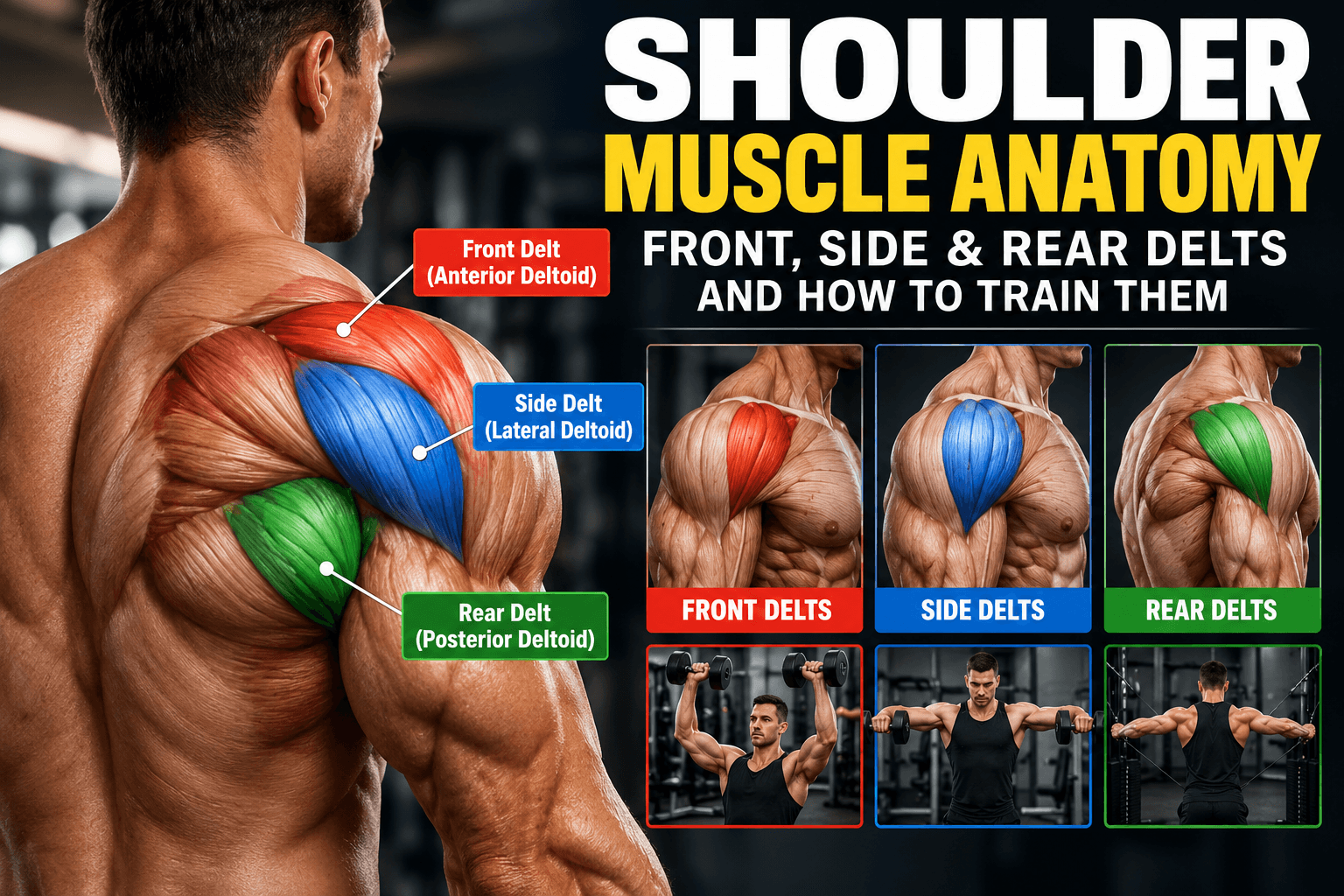
Understanding shoulder muscle anatomy helps you identify the muscles involved in shoulder movement, choose suitable exercises, and build a balanced shoulder workout. The shoulder muscles work together to move your arms, control pressing and pulling movements, and help stabilize the shoulder joint.
The deltoids are the main muscles responsible for the rounded appearance of the shoulders. They have three heads: anterior (front), lateral (side), and posterior (rear). Other muscles, including the rotator cuff, trapezius, and serratus anterior, contribute to shoulder movement and stability.
In this guide, you’ll learn what the main shoulder muscles do, how the front, side, and rear delts differ, and which exercises can help you train them.
Table of Contents
Shoulder Muscle Anatomy: The Main Muscles
The shoulder region includes several muscles that work together rather than functioning independently. For strength training, it helps to understand the deltoids, rotator cuff, and supporting muscles.
1. Deltoids
The deltoid is the large, triangular muscle covering the outer part of the shoulder. It has three heads, each with a different emphasis during arm movement.
- Anterior deltoid (front delt): Helps raise the arm forward and contributes to pressing movements.
- Lateral deltoid (side delt): Helps raise the arm out to the side and contributes to shoulder width.
- Posterior deltoid (rear delt): Helps move the upper arm backward and contributes to horizontal pulling movements.
All three heads can contribute to shoulder movement, but their relative involvement changes with the direction of the movement and the exercise being performed.
2. Rotator Cuff Muscles
The rotator cuff consists of four muscles that help control the shoulder joint and stabilize the head of the upper arm bone within the shoulder socket.
The four muscles are:
- Supraspinatus: Assists with initiating arm elevation and helps stabilize the shoulder.
- Infraspinatus: Contributes to external rotation of the upper arm.
- Teres minor: Assists with external rotation and shoulder stability.
- Subscapularis: Contributes to internal rotation and shoulder stability.
The rotator cuff has a different primary role from the deltoids. While the deltoids contribute substantially to moving the arm, the rotator cuff helps control the joint during movement.
External-rotation exercises can train some of these functions. For example, see the dumbbell horizontal external shoulder rotation guide.
For a more detailed medical explanation of shoulder anatomy, see the Hospital for Special Surgery’s shoulder resources.
3. Trapezius
The trapezius is a large muscle spanning the upper back and neck. Its different regions help control the shoulder blades during movements such as overhead pressing, raising the arms, and pulling.
The trapezius works with other muscles to position and move the shoulder blades. It is therefore involved in many shoulder exercises, even when the deltoids are the primary target.
4. Serratus Anterior
The serratus anterior lies along the side of the rib cage. It helps move the shoulder blade forward around the rib cage and contributes to upward rotation during overhead arm movements.
Its function is important because raising your arm overhead involves coordinated movement of both the upper arm and the shoulder blade.
Front Delt vs. Side Delt vs. Rear Delt
The three deltoid heads contribute differently to shoulder movement. Understanding their roles can help you select exercises that complement one another and build a balanced shoulder routine.
Front Delts: Anterior Deltoids
The front delts help raise the arm forward and contribute to pressing movements. They are involved in exercises such as shoulder presses and front raises.
Useful exercises include:
- Dumbbell shoulder press
- Barbell shoulder press
- Dumbbell front raise
The front delts already receive work from many chest-pressing and overhead-pressing movements. Your overall program should account for that involvement when deciding how much additional front-delt isolation work to include.
For exercise-specific instructions, see our front delt exercises guide and dumbbell shoulder press guide.
Side Delts: Lateral Deltoids
The side delts help raise the arms out to the sides. Developing this region can contribute to the rounded appearance and width of the shoulders.
Useful exercises include:
- Dumbbell lateral raise
- Cable lateral raise
- Other controlled lateral-raise variations
During lateral raises, use a weight that allows you to control the movement without excessive swinging. You do not need to lift the heaviest possible dumbbells to train the side delts effectively.
Our dumbbell full can lateral raise guide covers a related shoulder-raising variation.
Rear Delts: Posterior Deltoids
The rear delts help move the upper arm backward and contribute to horizontal abduction, in which the upper arm moves away from the body’s midline while raised.
Useful exercises include:
- Reverse flyes
- Rear-delt cable flyes
- Face pulls
During rear-delt exercises, focus on moving the upper arms while keeping the movement controlled. Avoid turning every repetition into a large torso swing.
You can learn more from our reverse cable flyes guide and face pull guide.
Best Exercises for Each Shoulder Muscle
No single exercise trains every shoulder muscle equally. A balanced selection should reflect your goals, the exercises already in your routine, and your ability to perform each movement comfortably.
| Shoulder muscle or region | Exercise examples | Main emphasis |
|---|---|---|
| Front delts | Dumbbell shoulder press, front raise | Forward arm elevation and pressing |
| Side delts | Lateral raise variations | Raising the arm out to the side |
| Rear delts | Reverse flyes, face pulls | Rear-shoulder movement and upper-back coordination |
| Rotator cuff | Controlled internal- and external-rotation exercises | Shoulder rotation and joint control |
Compound pressing exercises train the deltoids alongside other muscles, including the triceps. Isolation exercises can provide more direct emphasis on a particular deltoid head.
Exercise choice should also reflect your training experience, equipment, comfort, and any relevant physical limitations.
Rotator Cuff vs. Deltoids: What’s the Difference?
The deltoids and rotator cuff both contribute to shoulder function, but they have different primary roles.
The deltoids help move the upper arm. Their three heads contribute to forward elevation, sideways elevation, and backward or horizontal movement.
The rotator cuff consists of four muscles that help stabilize the shoulder joint and control rotation. These muscles work during many everyday and gym movements, including reaching and overhead pressing.
This distinction matters when planning a shoulder workout. Shoulder presses and lateral raises primarily emphasize deltoid movement, while controlled rotation exercises can specifically train rotator-cuff functions.
Neither group replaces the other. Both contribute to coordinated shoulder function, and the appropriate balance of exercises depends on your training goals and individual needs.
How to Build a Balanced Shoulder Workout
A balanced shoulder workout should consider all three deltoid heads, the pressing movements already included in your program, and your overall training volume.
1. Choose Exercises With Different Emphases
You could combine an overhead press with a lateral-raise variation and a rear-delt exercise. These movements emphasize different aspects of shoulder function.
You do not necessarily need a separate isolation exercise for every deltoid head in every session. Consider the work your chest, back, and other upper-body exercises already provide.
2. Use a Weight You Can Control
Select a resistance that allows you to maintain stable positioning and perform repetitions with consistent technique. If you must swing the weights, lean excessively, or shorten the movement unintentionally, reduce the load.
3. Progress Gradually
As your technique and strength improve, progress by adding repetitions or increasing resistance in manageable increments. Avoid increasing training demands faster than you can recover from them.
4. Allow Adequate Recovery
Muscles need recovery between demanding training sessions. The appropriate frequency depends on your total training volume, experience, and recovery capacity.
Rather than assuming that more shoulder exercises always produce better results, monitor your performance and adjust your routine as needed.
5. Train Within a Comfortable Range of Motion
Perform movements through a range you can control comfortably. Do not force a position that causes sharp pain or persistent discomfort. If symptoms continue, stop the aggravating movement and seek appropriate professional advice.
Common Shoulder-Training Mistakes
Overemphasizing the Front Delts
Overhead presses and chest-pressing exercises can already involve the front delts. Adding large amounts of front-raise work without considering your overall program may create unnecessary volume.
How to improve: Review your complete upper-body routine and include suitable side- and rear-delt work where appropriate.
Neglecting the Rear Delts
Some routines focus heavily on pressing movements and give less attention to exercises that emphasize the rear delts.
How to improve: Consider adding a controlled reverse-fly or face-pull variation if it fits your goals and program.
Using Momentum During Lateral Raises
Swinging the torso or jerking the weights can make it harder to maintain consistent technique.
How to improve: Reduce the resistance and perform each repetition with control.
Confusing Rotator-Cuff Training With Deltoid Training
The rotator cuff and deltoids contribute to different aspects of shoulder function. Training one group does not automatically replace training the other.
How to improve: Understand the purpose of each exercise and choose movements that fit your overall program.
Ignoring Pain
Sharp or persistent pain is not something you should simply push through to complete a set.
How to improve: Stop the painful movement. If symptoms persist or recur, seek assessment from a qualified healthcare professional.
Frequently Asked Questions
What are the three main shoulder muscles?
The deltoid has three heads: anterior (front), lateral (side), and posterior (rear). Each contributes differently to arm movement. The shoulder region also contains the rotator cuff and other muscles that help move and stabilize the shoulder.
Which shoulder muscle makes the shoulders look wider?
The lateral deltoids contribute to the rounded appearance and width of the shoulders. Lateral-raise variations are commonly used to emphasize this region.
Do shoulder presses train all three deltoid heads equally?
No. Shoulder presses primarily involve the front delts, with contributions from other shoulder muscles and the triceps. The relative involvement of each deltoid head depends on the exercise setup and movement pattern.
Are the rotator cuff and deltoids the same muscles?
No. The deltoids are a three-headed muscle group that contributes to arm movement. The rotator cuff is a group of four muscles that helps control and stabilize the shoulder joint and contributes to rotation.
Should I train front, side, and rear delts separately?
Not necessarily in every workout. Your exercise selection should account for the muscles emphasized by compound movements and your total training volume. Some routines benefit from additional isolation exercises, while others already provide substantial work for certain deltoid heads.
How often should I train my shoulders?
There is no single frequency that suits everyone. Consider your training experience, weekly volume, recovery, and how much shoulder work is included in chest and back sessions. Increase training demands gradually rather than adding sessions without considering recovery.
Can I train my shoulders if they hurt?
The appropriate response depends on the cause and severity of the pain. Do not push through sharp or persistent pain. Stop the aggravating exercise and seek professional assessment if the discomfort continues, worsens, or limits normal movement.
Key Takeaways
- The deltoids have three heads: anterior, lateral, and posterior.
- The front delts contribute to forward arm elevation and pressing; the side delts help raise the arms sideways; the rear delts contribute to backward and horizontal arm movement.
- The rotator cuff helps control and stabilize the shoulder joint and has functions distinct from the deltoids.
- A balanced shoulder routine should account for exercise emphasis, existing training volume, technique, and recovery.
- Choose controlled movements and stop exercises that cause sharp or persistent pain.
Conclusion
Understanding shoulder muscle anatomy helps you make more informed decisions about exercise selection and training balance. The front, side, and rear delts contribute differently to arm movement, while the rotator cuff and supporting muscles help control the shoulder during activity.
A well-planned routine can combine pressing, lateral-raise, and rear-delt movements according to your goals and existing training program. Start with exercises you can perform comfortably, maintain controlled technique, and progress gradually.
Explore our individual shoulder exercise guides to learn the setup, technique, and key cues for each movement.