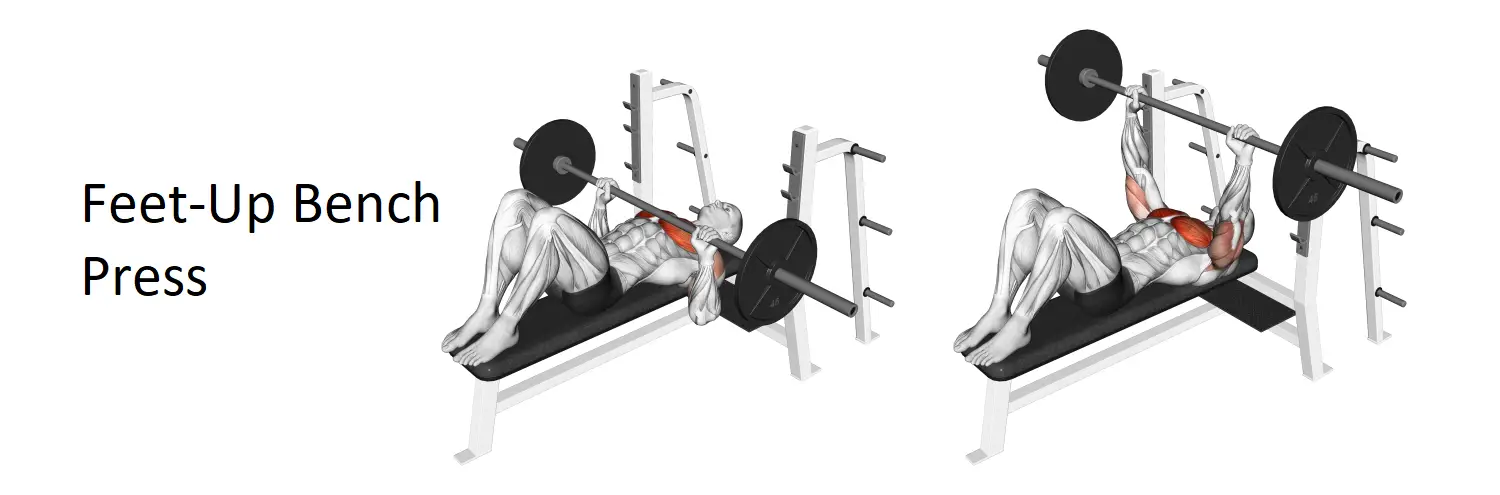
The feet-up bench press is a variation of the traditional bench press performed with the feet raised instead of planted on the floor. Depending on the version, the feet may rest on the bench or remain suspended with the hips and knees bent. Removing normal foot support changes the stability demands of the lift and generally requires using less weight than a conventional bench press.
This guide explains how to perform the feet-up bench press, which muscles it works, its potential benefits and limitations, common mistakes, and how to use it in a strength-training routine.
Table of Contents
What Is the Feet-Up Bench Press?
The feet-up bench press is a horizontal pressing exercise performed on a flat bench with the feet raised. It primarily trains the chest, front shoulders, and triceps, as does a conventional bench press.
There are two common setups:
- Feet resting on the bench: The knees are bent and the feet rest securely on the bench. This provides a more stable position than suspending the feet in the air.
- Feet suspended: The hips and knees remain bent while the feet are held off the bench and floor. This requires additional balance and trunk control.
These setups are not identical. For most people learning the movement, resting the feet on the bench is the more practical starting point. The suspended-foot version is more demanding and should not be treated as a way to lift heavier weights.
Unlike the standard bench press, the feet-up variation removes the usual foot contact with the floor. This limits leg drive and changes how the lifter stabilizes the torso.
Muscles Worked
The feet-up bench press trains many of the same upper-body muscles as the conventional bench press.
Primary Muscles
Pectoralis major (chest): The chest muscles produce much of the force needed to press the bar away from the body.
Anterior deltoids (front shoulders): These muscles assist with moving the upper arms during the pressing movement.
Triceps brachii: The triceps extend the elbows as the bar is pressed toward the starting position.
Supporting Muscles
The muscles around the shoulder blades and torso help maintain a stable pressing position. Depending on the variation, the abdominal muscles and hip flexors may also contribute to maintaining the raised-leg position.
The precise contribution of each muscle depends on the load, grip, technique, and whether the feet rest on the bench or remain suspended. Do not assume that greater instability automatically means greater muscle growth.
Equipment and Setup
You will need a flat weight bench, a barbell with suitable weight plates, a rack with correctly positioned safety arms or pins, and a competent spotter when appropriate.
Before lifting:
- Position the bench securely inside the rack.
- Adjust the rack hooks so you can unrack and rerack the bar without stretching excessively.
- Set the safety arms or pins to an appropriate height so they can help prevent the bar from trapping you if a repetition fails.
- Load the bar conservatively, especially when trying the variation for the first time.
- If you are new to the exercise, begin with a lighter implement or ask a qualified trainer to help you establish the setup.
Never attempt a heavy barbell bench press without a safe way to manage a failed repetition.
How to Perform the Feet-Up Bench Press
The following steps describe the feet-on-bench version, which is the recommended starting option for most people learning this variation.
Step 1: Lie on the Bench
Lie on your back with your eyes approximately beneath the bar. Keep your head and upper back in contact with the bench.
Step 2: Establish Your Upper-Body Position
Grip the bar slightly wider than shoulder-width, adjusting to a comfortable position that allows your forearms to remain reasonably vertical near the bottom of the lift. Pull your shoulder blades back and down against the bench.
Keep your wrists aligned with your forearms and wrap your thumbs around the bar.
Step 3: Place Your Feet on the Bench
Bend your knees and place both feet securely on the bench. Choose a position that allows you to remain balanced without rocking or twisting your pelvis.
Do not lift your feet into the air unless you are intentionally performing that more demanding variation and can maintain control.
Step 4: Unrack the Bar
With a spotter’s help if needed, lift the bar from the rack and position it above your chest with your elbows extended but not forcefully locked.
Keep your shoulders supported and your body stable. Do not let the bar drift unpredictably while you establish your starting position.
Step 5: Lower the Bar Under Control
Bend your elbows and lower the bar toward the middle of your chest. Keep your wrists aligned and your elbows at a comfortable angle relative to your torso.
Lower the bar smoothly without bouncing it off your chest or allowing your shoulders to roll forward.
Step 6: Press the Bar Up
Press the bar upward until your elbows return to the starting position. Keep your upper back supported, your feet stable, and your movement controlled.
Avoid shifting your hips, twisting your body, or changing your foot position during the repetition.
Step 7: Finish the Set Safely
Complete only repetitions you can control. When the set is finished, guide the bar back to the rack hooks with the help of your spotter if needed.
Do not try to rescue a failed repetition by throwing your feet down or twisting under the bar.
Benefits and Limitations
The feet-up bench press can be useful when there is a clear training reason to reduce leg drive and change the demands of the pressing movement. It is not automatically better than a standard bench press.
Potential Benefits
Reduced reliance on leg drive: Raising the feet removes the usual foot contact with the floor, so the lifter cannot use the same lower-body support as in a conventional bench press.
A different stability challenge: The lifter must maintain a stable upper body while pressing without the usual base provided by the feet on the floor.
An alternative pressing variation: The exercise can add variety to a chest-training program or serve as a lighter accessory movement for someone who already has consistent bench-press technique.
Practice with controlled loading: Because the setup is less stable, many lifters need to use less weight than they would with a conventional bench press.
Important Limitations
The feet-up bench press generally does not allow the same loading or leg drive as the conventional bench press. It should not replace standard bench pressing if your primary goal is to practice or maximize performance in the conventional lift.
It also does not guarantee better posture, safer shoulders, less lower-back strain, or greater muscle growth. Individual comfort and training outcomes vary, and the feet-suspended version can be more challenging to stabilize.
A small 2019 study compared muscle activation during bench pressing with the feet on the floor versus with the hips and knees flexed and the feet unsupported. The researchers reported differences in muscle activation during their test protocol, but this does not prove that the feet-up variation produces better long-term strength or muscle-growth outcomes for everyone. Read the original study in PLOS ONE for the details and limitations.
Common Mistakes
Using Too Much Weight
The raised-foot position changes stability and removes the usual support from the floor. Using your normal heavy bench-press load can make it difficult to control the bar. Start lighter and increase resistance only when your technique is consistent.
Confusing the Two Foot Positions
Resting the feet on the bench and holding them suspended in the air are different setups. Choose one intentionally and keep the instructions consistent throughout each set.
Letting the Shoulders Roll Forward
Allowing the shoulder blades to move excessively or the shoulders to roll forward can reduce control during the lift. Establish a stable upper-back position before unracking the bar and maintain it throughout the repetition.
Bouncing the Bar Off the Chest
Bouncing the bar uses momentum and makes the bottom of the movement harder to control. Lower the bar smoothly and press without rebounding it from the chest.
Losing Wrist Alignment
Excessive wrist bending can make the bar harder to control. Keep your wrists aligned with your forearms and grip the bar securely.
Attempting Heavy Repetitions Without Safety Measures
The feet-up position can make balance and recovery from a failed repetition more difficult. Use properly adjusted safety arms or pins and a spotter when appropriate. Do not attempt maximum-effort lifts while learning the variation.
Sets, Reps, and Progression
The appropriate training volume depends on your experience, goals, and overall program. There is no single set-and-repetition prescription that is best for everyone.
Start With Controlled Repetitions
Choose a load that allows you to maintain a stable upper body, a consistent bar path, and controlled lowering. If you are unfamiliar with the variation, begin with a lighter implement or seek coaching before using a loaded barbell.
Progress Gradually
Increase the load only after you can perform the exercise consistently without losing balance or control. Change one training variable at a time, and avoid using heavier weight simply to match your conventional bench press.
How to Include It in a Workout
The feet-up bench press may be used as an accessory variation after you have established your primary pressing exercise. It can also be used in a lighter session where reducing leg drive is intentional.
If your main goal is to improve your standard bench press, keep practicing the standard version as appropriate. Use the feet-up variation to address a specific training purpose rather than assuming it is a direct replacement.
Safety Considerations
Although the feet-up bench press looks similar to a conventional bench press, the altered position can make the lift harder to stabilize.
- Use a weight you can control throughout the full repetition.
- Set the safety arms or pins before unracking the bar.
- Use a spotter when appropriate, particularly when using a barbell.
- Keep your head and upper back supported on the bench.
- Avoid sudden changes in foot position during a repetition.
- Stop if you experience sharp pain, dizziness, unusual weakness, or other concerning symptoms.
If you have a current shoulder, chest, back, or other musculoskeletal injury, seek individualized advice from a qualified healthcare professional before attempting a variation that changes your stability or loading.
Variations and Alternatives
Conventional Barbell Bench Press
The standard bench press is performed with the feet planted on the floor. It allows the lifter to establish a more stable base and use leg drive where appropriate.
Dumbbell Chest Press
The dumbbell chest press uses two independent weights. It offers a different pressing experience and requires each arm to control its own dumbbell.
Incline Bench Press
The incline bench press changes the angle of the torso and places different demands on the chest and shoulder muscles. It is an alternative when the goal is to vary pressing angles rather than remove leg drive.
Push-Ups
Push-ups provide a bodyweight pressing alternative that can be scaled by changing the incline, range of motion, or variation. They do not require a barbell rack.
Dumbbell Chest Fly
The dumbbell chest fly is an accessory movement that emphasizes bringing the arms together across the chest. It is not a direct replacement for a pressing exercise because the movement and loading pattern are different.
Choose alternatives according to your training goal, equipment, and experience rather than assuming that all chest exercises provide the same stimulus.
Frequently Asked Questions
Is the feet-up bench press harder than a regular bench press?
It can be harder to stabilize because the feet are no longer planted on the floor. Many lifters use less weight than they would in a conventional bench press. The difficulty depends on the setup, load, and experience.
Should my feet rest on the bench or stay in the air?
For most people learning the variation, resting both feet securely on the bench is a practical starting point. Holding the feet suspended is a different and more demanding setup that requires additional control.
Which muscles does the feet-up bench press work?
The primary muscles are the pectoralis major, anterior deltoids, and triceps. Muscles around the shoulder blades and torso help stabilize the body, with their contribution varying by technique.
Can the feet-up bench press build chest muscle?
It can train the chest muscles as part of a suitable resistance-training program. Muscle growth depends on factors such as training volume, effort, progression, recovery, and nutrition. The feet-up position itself does not guarantee superior results.
Can I use the same weight as my regular bench press?
Usually, you should start with less weight because removing foot support changes the stability demands. Choose a load based on your ability to control the bar safely, not on the weight used for conventional bench pressing.
Is the feet-up bench press safer for the lower back?
It should not be described as universally safer for the lower back. The exercise changes body position, and individual comfort varies. If a movement causes pain or you have an existing injury, stop and seek appropriate guidance.
Should beginners perform the feet-up bench press?
Beginners should first learn basic bench-press setup, bar control, and safe use of the rack. If they try the feet-up version, they should use conservative resistance and receive qualified instruction when needed.
Conclusion
The feet-up bench press is a variation of the barbell bench press that removes the usual support provided by planting the feet on the floor. It trains the chest, front shoulders, and triceps while changing the stability demands of the movement.
Start with a manageable load, keep your upper body stable, and choose a consistent foot position. Use proper rack safety measures and a spotter when appropriate. Treat the exercise as a purposeful variation rather than a guaranteed improvement over the standard bench press.