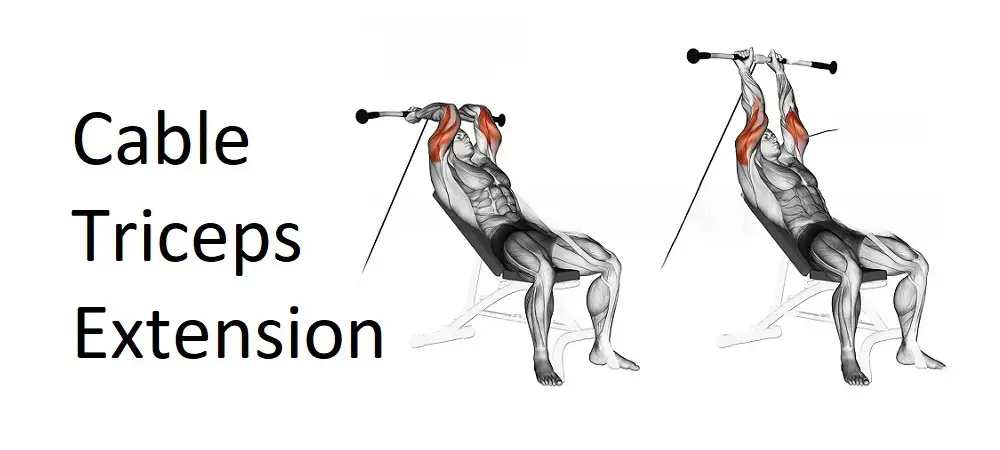
The cable triceps extension is an effective isolation exercise for strengthening the triceps brachii, the muscle group on the back of your upper arm. By extending your elbows against resistance from a cable machine, you can train your triceps with a controlled movement and adjust the load to suit your experience level.
Cable triceps extensions can refer to several exercises, including the standing cable triceps pushdown and the overhead cable triceps extension. This guide focuses primarily on the standing cable triceps extension, also known as the cable triceps pushdown, while explaining how it differs from the overhead variation.
You will learn how to perform the movement, which muscles it trains, how to choose an attachment, common technique mistakes, and how to include it in your workout.
Table of Contents
What Is the Cable Triceps Extension?
The cable triceps extension is an isolation exercise that trains elbow extension against resistance. In the standard standing version, you attach a handle or bar to a high cable pulley, keep your upper arms close to your torso, and push the attachment downward by straightening your elbows.
The exercise is commonly called a cable triceps pushdown. Although the names are often used interchangeably, cable triceps extensions can also describe overhead variations in which your upper arms are positioned beside your head.
The standing pushdown is popular because it is relatively easy to learn, the resistance can be adjusted in small increments, and the movement can be performed with different attachments.
Exercise overview
- Primary muscles: Triceps brachii
- Equipment: Cable machine and a compatible attachment
- Exercise type: Isolation
- Movement pattern: Elbow extension
- Difficulty: Beginner-friendly when performed with appropriate resistance
- Common placement: After compound pressing exercises or during an arm workout
Muscles Worked by the Cable Triceps Extension
1. Triceps Brachii
The triceps brachii is the primary muscle group responsible for extending your elbow. It has three heads: the long head, lateral head, and medial head.
All three heads contribute to elbow extension during the cable pushdown. Their relative contribution can vary with joint position, technique, resistance, and individual anatomy. The standing pushdown should not be treated as a movement that completely isolates only one triceps head.
2. Forearm Muscles
Your forearm muscles help you maintain a secure grip on the attachment and keep your wrists stable. A comfortable grip and neutral wrist position make it easier to control the cable throughout the repetition.
3. Core and Shoulder Stabilizers
Your abdominal and trunk muscles help keep your torso steady, while muscles around the shoulders help maintain your upper-arm position. These muscles support the exercise, but the triceps should remain the primary focus.
Benefits of Cable Triceps Extensions
1. Direct Triceps Training
Cable extensions allow you to train elbow extension directly. They complement compound movements such as bench presses and push-ups, which also involve the triceps alongside other upper-body muscles.
2. Adjustable Resistance
Most cable machines allow small changes in resistance. This makes it easier to select a manageable load, practice good technique, and increase the weight gradually as your strength improves.
3. Controlled Repetitions
The cable provides resistance during both the downward phase and the return. You can use this to practice smooth, controlled repetitions rather than allowing the weight to drop or swing.
4. Attachment Options
A rope, straight bar, or angled bar can provide different grip positions. Choose an attachment that allows you to keep your wrists comfortable and your elbows in a stable position.
5. Easy to Include in an Upper-Body Workout
Cable triceps extensions can fit into an upper-body, push, or arm-training session. They are commonly performed after larger compound exercises, although the best order depends on your training goals and overall program.
Equipment and Setup
You need a cable machine with a high pulley and a compatible attachment.
Common options include:
- Rope attachment: Allows each hand to move naturally and the rope ends to separate slightly at the bottom.
- Straight bar: Provides a stable, straightforward grip.
- Angled or V-bar: May feel more comfortable for some lifters who prefer a fixed hand position.
There is no single attachment that is best for everyone. Start with the option that lets you perform the movement without wrist discomfort or excessive elbow movement.
Before beginning, adjust the pulley to a high position, secure the attachment, and select a light starting weight. Check that the attachment is firmly connected before lifting.
How to Perform the Cable Triceps Extension
Follow these steps for the standard standing cable triceps extension, or cable pushdown.
Step 1: Set the Pulley and Choose Your Weight
Attach a rope or bar to the high pulley. Select a resistance that allows you to complete your repetitions without swinging your body or moving your upper arms excessively.
Step 2: Take Your Starting Position
Stand facing the machine with your feet approximately shoulder-width apart. Keep your knees slightly bent, brace your abdomen, and maintain a comfortable, stable torso position.
Step 3: Grip the Attachment
Hold the attachment securely. Bend your elbows so your forearms are raised in front of you, and position your upper arms close to your sides.
Keep your wrists in a comfortable, mostly neutral position rather than bending them sharply.
Step 4: Extend Your Elbows
Breathe out as you push the attachment downward by straightening your elbows. Keep your upper arms relatively stationary and avoid using your shoulders or body weight to force the cable down.
Continue until your arms reach a comfortable, controlled extension.
Step 5: Contract Your Triceps
Briefly tighten your triceps at the bottom of the movement. If you use a rope, you can allow the ends to separate slightly, provided this feels comfortable and does not twist your wrists.
Do not force your elbows into a painful or aggressive lockout.
Step 6: Return Under Control
Breathe in as you slowly allow the attachment to rise. Bend your elbows while maintaining control of the resistance and keeping your upper arms close to your sides.
Return to your starting position without allowing the weight stack to pull your arms upward abruptly.
Step 7: Repeat
Complete your planned repetitions using the same controlled technique. If your torso begins to swing or your elbows repeatedly move out of position, reduce the weight.
Technique reminder: Keep the torso steady, control the return, and let elbow extension—not body momentum—drive the movement.
Common Mistakes to Avoid
1. Using Too Much Weight
Excessive resistance often causes lifters to lean, swing, or use their shoulders to move the attachment.
Correction: Reduce the load until you can complete each repetition with a steady torso and controlled elbow movement.
2. Moving the Upper Arms Excessively
Allowing your elbows to travel forward and backward changes the movement and makes it harder to maintain the intended pushdown pattern.
Correction: Keep your upper arms close to your sides. Small natural adjustments are acceptable; avoid turning the exercise into a full-body pressing movement.
3. Letting the Weight Pull You Up
Allowing the cable to jerk your arms upward removes control from the return phase and can make the exercise uncomfortable.
Correction: Resist the cable as you bend your elbows and return to the starting position smoothly.
4. Bending the Wrists
Excessive wrist flexion or extension can make gripping the attachment uncomfortable.
Correction: Keep your wrists aligned with your forearms and choose a grip that feels natural.
5. Using a Short or Inconsistent Range of Motion
Repeating only a small part of the movement can make it harder to compare your performance from set to set.
Correction: Use a comfortable range that you can control consistently. Avoid forcing the elbows into positions that cause pain.
6. Rushing Through Repetitions
Fast, uncontrolled repetitions can make it difficult to keep the upper arms steady and maintain tension against the cable.
Correction: Push down smoothly, pause briefly if comfortable, and return under control.
Sets, Reps, and Training Tips
The appropriate training volume depends on your experience, goals, and the rest of your program. The following ranges are practical starting points, not universal requirements.
| Goal | Sets | Repetitions |
|---|---|---|
| General fitness | 2–3 | 10–15 |
| Muscle growth | 3–4 | 8–15 |
| Muscular endurance | 2–3 | 15–20 |
Rest for approximately 60–120 seconds between sets, adjusting the duration based on how demanding the set feels and how well you recover.
How to Progress
- Start with a load you can control through the intended range of motion.
- Practice consistent technique before increasing resistance.
- Add repetitions gradually while maintaining good form.
- When you can complete the upper end of your chosen repetition range comfortably for all sets, consider a small increase in weight.
- Reduce the load if the next session causes you to swing, shorten the movement, or lose control.
You do not need to train to complete failure on every set. Leave some repetitions in reserve when appropriate, especially while learning the exercise.
Cable Triceps Extension Variations
1. Rope Cable Triceps Pushdown
This version uses a rope attachment. It allows your hands to move independently and the rope ends to separate slightly at the bottom.
Best for: Lifters who prefer a flexible grip and a natural wrist position.
2. Straight-Bar Cable Triceps Pushdown
The straight bar provides a fixed grip and may feel stable for lifters who prefer both hands on one attachment.
Best for: Those who find a straight-bar grip comfortable and can maintain good wrist alignment.
3. V-Bar Cable Triceps Pushdown
An angled or V-shaped attachment changes the hand position compared with a straight bar. Comfort and control should guide your choice.
Best for: Lifters who prefer an angled grip.
4. Reverse-Grip Cable Pushdown
This variation uses an underhand grip. Some people find it more comfortable for their wrists, while others prefer a neutral or overhand grip.
Best for: Lifters who can perform it comfortably without reducing control.
5. Overhead Cable Triceps Extension
The overhead version positions the upper arms beside or above the head, with the cable resisting elbow extension from behind the body.
This changes the shoulder position and lengthens the triceps long head more than the standard pushdown position. It is a distinct exercise, not simply another grip for the same movement.
Best for: People who want to include an overhead elbow-extension exercise in their triceps program and can perform it comfortably.
Cable Triceps Extension vs. Overhead Cable Extension
Both exercises train the triceps, but they differ in shoulder position and setup.
| Feature | Standing cable pushdown | Overhead cable extension |
|---|---|---|
| Upper-arm position | Close to the torso | Raised beside or above the head |
| Main movement | Elbow extension | Elbow extension |
| Setup | High pulley, attachment in front | Cable positioned to provide resistance during overhead elbow extension |
| Main consideration | Keep the upper arms steady | Use a comfortable shoulder position and controlled range |
| Practical role | Direct triceps accessory | Complementary triceps exercise |
Research comparing overhead and neutral-arm cable elbow extensions found greater triceps muscle growth in the overhead condition in a 12-week study of 21 adults. This supports including overhead work when suitable, but it does not mean that every person must perform overhead extensions or that the standard pushdown is ineffective.
Read the study: Maeo and colleagues, European Journal of Sport Science, via PubMed.
Alternatives to Cable Triceps Extensions
If a cable machine is unavailable or the movement does not suit you, consider these alternatives.
1. Diamond Push-Ups
Diamond push-ups use a close hand position to challenge the triceps along with the chest and shoulders. They also require you to control your body weight.
Read more: Diamond Push-Ups: The Ultimate Guide to Building Triceps.
2. Wide-Grip Push-Ups
Wide-grip push-ups emphasize the chest and shoulders more than a narrow hand position, but the triceps still contribute to elbow extension.
Read more: Wide-Grip Push-Ups: The Ultimate Guide.
3. Dumbbell Shoulder Press
The dumbbell shoulder press is a compound pressing exercise that trains the shoulders and involves the triceps. It is not a direct replacement for an isolation exercise, but it can complement a balanced upper-body program.
Read more: Dumbbell Shoulder Press: Proper Form, Muscles Worked & Benefits.
Choose an alternative based on your equipment, comfort, and the role the exercise needs to play in your workout.
Safety Tips
- Start with a manageable weight and increase it gradually.
- Check the cable, pulley, and attachment before each set.
- Keep your feet stable and avoid leaning your entire body into the resistance.
- Use a comfortable range of motion rather than forcing your elbows straight.
- Stop if you experience sharp pain, numbness, or unusual joint discomfort.
- If an existing elbow, shoulder, or wrist problem affects your training, seek advice from a qualified healthcare professional before continuing movements that aggravate it.
Muscle effort and fatigue are normal during resistance training, but pain should not be ignored.
Frequently Asked Questions
What muscles do cable triceps extensions work?
Cable triceps extensions primarily work the triceps brachii, which extends the elbow. The forearms help maintain the grip, while the trunk and shoulder stabilizers help keep the body and upper arms steady.
Are cable triceps extensions the same as triceps pushdowns?
The terms are often used interchangeably for the standing high-pulley pushdown. However, cable triceps extensions can also refer to overhead variations, so check the setup when following an exercise guide.
Is a rope or straight bar better for triceps extensions?
Neither attachment is universally better. A rope permits a more flexible hand position, while a straight bar provides a fixed grip. Choose the one that lets you maintain comfortable wrists, stable upper arms, and controlled repetitions.
How many sets of cable triceps extensions should I do?
Two to four sets can be a reasonable starting point, depending on your training experience and weekly program. Adjust the number of sets according to your recovery and the amount of other pressing and triceps work you perform.
Can beginners do cable triceps extensions?
Yes. Beginners can start with a light load and focus on keeping their torso steady, their wrists comfortable, and their upper arms close to their sides. Increase resistance only when technique remains consistent.
Should I lock out my elbows at the bottom?
Aim for a controlled, comfortable extension. Do not forcefully snap or hyperextend your elbows. If full extension causes discomfort, adjust your range of motion and consider seeking qualified guidance.
Are overhead cable extensions better than pushdowns?
They train the triceps with different shoulder positions. A controlled study found greater triceps growth with overhead cable elbow extensions than neutral-arm extensions over 12 weeks, but exercise choice should also consider comfort, technique, goals, and the rest of your program.
How often should I train triceps?
Frequency depends on your overall training volume, experience, and recovery. Many people train triceps as part of one or more upper-body or push sessions each week. Allow enough recovery between demanding sessions and avoid adding volume simply for the sake of doing more.
Final Thoughts
The cable triceps extension is a practical exercise for adding direct triceps work to your training routine. Consistent technique matters more than using the heaviest weight on the stack: keep your torso steady, control the return, maintain a comfortable wrist position, and extend your elbows without forcing the joint.
Start with a manageable load, progress gradually, and choose an attachment that feels comfortable. If your goal is to train the triceps through different shoulder positions, consider pairing the standing pushdown with an overhead extension when appropriate.
With consistent training, sensible progression, and adequate recovery, cable triceps extensions can be a useful part of a well-rounded upper-body program.