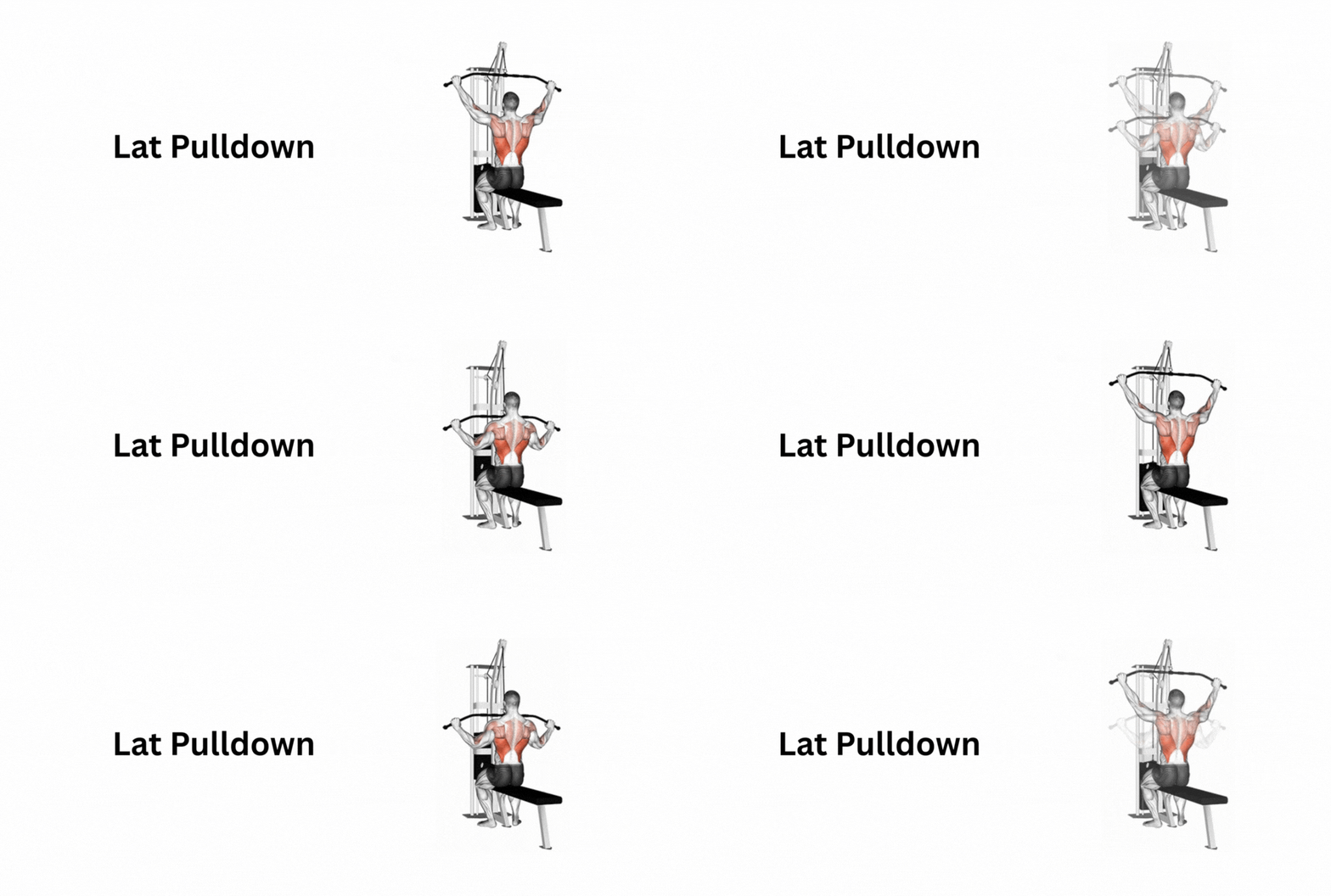
The lat pulldown is a cable-machine exercise that primarily trains the latissimus dorsi, or lats, along with the biceps and other upper-back muscles. It is useful for building pulling strength and back muscle, and it allows you to adjust the resistance instead of lifting your full bodyweight as you would during a pull-up.
To perform a lat pulldown, secure your thighs under the machine pad, grasp the bar with a comfortable overhand grip, and pull it toward your upper chest by driving your elbows down. Keep your torso stable and return the bar slowly to the starting position.
Table of Contents
How to Do the Lat Pulldown
Use these steps to perform the standard seated lat pulldown with controlled technique.
Step 1: Set Up the Machine
- Adjust the seat so you can reach the bar without standing up or stretching uncomfortably.
- Set the thigh pad firmly against your thighs so your body stays seated during the pull.
- Place your feet flat on the floor.
- Choose a straight bar or another attachment that allows a comfortable grip.
Step 2: Get Into Position
- Grasp the bar with an overhand grip, with your hands slightly wider than shoulder-width apart as a starting point.
- Sit tall with your chest comfortably lifted and your spine in a neutral position.
- Extend your arms overhead without forcing your shoulders into an uncomfortable position.
- Lean back only slightly if needed to let the bar travel in front of your face.
- Brace your core and keep your head aligned with your torso.
Step 3: Pull the Bar Down
- Begin the movement by drawing your upper arms down toward your sides.
- Drive your elbows down and slightly back rather than pulling only with your hands.
- Bring the bar toward your upper chest, stopping when you can no longer pull lower without excessive leaning or changing your shoulder position.
- Keep your torso steady instead of rocking backward to move the weight.
- Pause briefly if you can maintain control.
Do not pull the bar behind your neck. The standard front pulldown trains the same general pulling pattern without requiring the same behind-the-head position.
Step 4: Return to the Starting Position
- Let the bar travel upward slowly under control.
- Allow your arms to extend as your lats lengthen.
- Keep your torso stable and avoid letting the weight stack pull your shoulders abruptly upward.
- Repeat for the planned number of repetitions.
Form tip: If you need to swing your body, shorten the range of motion substantially, or jerk the bar to complete a repetition, reduce the weight.
What Muscles Does the Lat Pulldown Work?
The lat pulldown is a compound pulling exercise. The lats are the primary target, while several other muscles assist with moving the arms, bending the elbows, and controlling the shoulder blades.
| Muscle | Role during the lat pulldown |
|---|---|
| Latissimus dorsi (lats) | Primary target; helps bring the upper arms down toward the torso |
| Teres major | Assists the lats with shoulder movement |
| Biceps brachii | Helps bend the elbows during the pull |
| Brachialis and brachioradialis | Assist elbow flexion |
| Rhomboids | Help control the shoulder blades |
| Middle and lower trapezius | Contribute to shoulder-blade control and stability |
| Rear deltoids | Assist with shoulder movement, depending on technique |
| Forearm and grip muscles | Help hold the bar securely |
| Core muscles | Help stabilize the torso |
The exact contribution of each muscle depends on your grip, body position, range of motion, resistance, and individual anatomy. The exercise should not be treated as a complete replacement for horizontal pulling movements such as rows.
Benefits of the Lat Pulldown
1. Builds Back Strength and Muscle
The lat pulldown trains the lats and supporting muscles through a vertical pulling movement. With consistent training, suitable resistance, and progressive overload, it can help develop back strength and muscle size.
2. Makes Resistance Easier to Adjust
Unlike an unassisted pull-up, the machine lets you select a load that matches your current ability. This makes it easier to start with manageable resistance, practise technique, and gradually increase the challenge.
3. Helps Develop Pulling Strength for Pull-Ups
The lat pulldown and pull-up share a vertical pulling pattern. Building strength on the pulldown can support pull-up training, although it does not fully replace practising pull-ups or assisted pull-ups.
4. Supports Structured Back Training
The exercise can be used as a main back movement or as additional pulling volume alongside rows and other back exercises. Its adjustable load makes it practical for a range of training experience levels.
5. Allows Different Grip Options
Different handles and grip positions let you adjust the movement to your comfort, equipment, and training preferences. You do not need to use an extremely wide grip to train your lats effectively.
Lat Pulldown Grip Types Explained
Grip choice affects comfort, range of motion, and the contribution of supporting muscles. No single grip is best for every person, and grip changes do not completely isolate one area of the back.
Wide Overhand Grip
Place your hands wider than shoulder-width apart with your palms facing away from you.
- Creates a wider hand position and may feel more challenging through the available range of motion.
- Trains the lats along with other muscles involved in vertical pulling.
- Use a width that allows a controlled pull without shoulder discomfort.
Avoid going excessively wide if it limits your range of motion or makes the movement uncomfortable.
Shoulder-Width or Close Overhand Grip
Use an overhand grip around shoulder-width apart or somewhat narrower.
- Provides a useful starting position for many lifters.
- Allows a comfortable range of motion for some people.
- Continues to train the lats while involving the elbow flexors and other back muscles.
A narrower grip does not automatically mean that the biceps take over. The load and how you perform the repetition also matter.
Neutral Grip
Use parallel handles so your palms face each other.
- May feel more comfortable for some wrists and shoulders.
- Allows a natural-feeling arm path.
- Is a useful option when a straight bar feels awkward.
Comfort varies by individual. If a neutral grip causes pain, try a different attachment or stop the exercise.
Underhand Grip
Use a grip with your palms facing toward you.
- Increases the role of the elbow flexors, including the biceps, for many lifters.
- Can resemble the grip used during a chin-up.
- Provides another way to vary your pulling routine.
Choose a load that allows you to keep your wrists comfortable and your torso controlled.
Common Lat Pulldown Mistakes and How to Fix Them
| Mistake | Why it matters | How to fix it |
|---|---|---|
| Using too much weight | Encourages swinging and reduces control | Lower the load until you can complete smooth repetitions |
| Leaning too far backward | Changes the movement toward a row | Keep a small, consistent torso lean |
| Pulling behind the neck | Requires a less comfortable shoulder and neck position for many people | Pull the bar in front of your head toward your upper chest |
| Pulling only with the hands | Makes it harder to coordinate the intended pulling movement | Think about driving your elbows down |
| Cutting the range of motion short | Reduces the movement you perform in each repetition | Use the largest comfortable range you can control |
| Letting the weight snap upward | Removes control from the return phase | Guide the bar upward slowly |
| Shrugging throughout the movement | May indicate that the load or technique needs adjusting | Reduce the load and practise controlled shoulder-blade movement |
| Forcing an uncomfortable grip | Can make the exercise unpleasant or painful | Change the grip width or attachment |
You do not need to exaggerate the shoulder-blade squeeze at the bottom. Focus on a controlled pull and a comfortable, repeatable range of motion.
Lat Pulldown Variations
You can use variations to change the handle, movement pattern, or training emphasis. Start with the standard lat pulldown until you can perform it consistently.
Single-Arm Lat Pulldown
Use a single handle and train one side at a time.
- Helps you practise each side independently.
- Allows you to adjust your arm path to a comfortable position.
- Makes it easier to notice differences in control between sides.
Use a stable seated or kneeling position and avoid twisting your torso to finish the pull.
Straight-Arm Pulldown
Stand facing a high cable pulley and hold a bar or rope with your arms nearly straight and elbows softly unlocked. Pull the attachment down in an arc toward your thighs, then return it slowly overhead.
This variation emphasizes shoulder extension and reduces the amount of elbow bending compared with a standard lat pulldown. Keep the weight manageable and avoid turning it into a triceps pushdown.
V-Bar or Close Neutral-Grip Pulldown
Use a V-shaped handle or close neutral-grip attachment.
- Provides a closer hand position.
- May offer a comfortable wrist and arm path.
- Trains the lats alongside the biceps and other pulling muscles.
Do not lean far back to move a heavier load.
Controlled-Tempo or Pause Repetitions
Keep the same basic exercise but slow down the return or pause briefly at the bottom.
- Helps you practise control.
- Makes it easier to notice unwanted swinging.
- Can increase the time spent performing each repetition.
A slow tempo is a training option, not a requirement for muscle growth. Use a tempo you can maintain without pain or loss of position.
Lat Pulldown vs. Pull-Ups
Both exercises train vertical pulling muscles, including the lats and elbow flexors. The best choice depends on your current ability, equipment, and goals.
| Feature | Lat pulldown | Pull-up |
|---|---|---|
| Resistance | Adjustable machine load | Bodyweight, with assistance or added weight when appropriate |
| Difficulty adjustment | Change the selected load | Use an assisted machine or band, or progress to added weight |
| Main benefit | Makes load and volume easier to scale | Develops bodyweight pulling skill and relative strength |
| Equipment | Cable machine and suitable attachment | Pull-up bar; assistance may be useful |
| Useful for beginners | Yes, with manageable resistance | Yes, using an appropriate assisted variation |
| Training application | Strength and muscle-building work | Strength, skill and muscle-building work |
Which Is Better for Muscle Growth?
Both exercises can build muscle when performed with appropriate resistance, sufficient effort, and progressive training. The lat pulldown makes it easier to adjust the load in small increments, while pull-ups provide practice at lifting and controlling your bodyweight.
Neither exercise is universally superior for every lifter.
Which Is Better for Beginners?
The lat pulldown can be an accessible starting point because you can choose a manageable load. Assisted pull-ups are another option for learning the movement pattern.
If your goal is to perform unassisted pull-ups, include pull-up practice as your strength improves rather than relying exclusively on pulldowns.
Can You Train Both in the Same Workout?
Yes. One option is to perform pull-ups or assisted pull-ups first while you are fresh, then use lat pulldowns for additional pulling volume. You can also place the pulldown first if it better suits your current training priority.
Balance vertical pulls with a horizontal pulling exercise, such as a row, for a more complete back session.
Lat Pulldown Sets, Reps and Progression
Your sets and repetitions should match your experience, goals, and recovery. The following ranges are practical starting points rather than strict rules.
| Goal | Starting prescription | Main focus |
|---|---|---|
| General strength and technique | 2–4 sets of 6–10 reps | Controlled repetitions and consistent form |
| Muscle growth | 3–4 sets of 8–12 reps | Challenging sets with good technique |
| Muscular endurance | 2–3 sets of 12–15 reps | Maintaining control as fatigue increases |
Rest long enough between sets to perform the next set with good technique. Around 1–3 minutes is a reasonable starting point, with longer rests if heavier sets require them.
How Often Should You Do Lat Pulldowns?
Many people can begin with one or two weekly sessions, depending on their overall back-training volume and recovery. Some training plans use the movement more often, but more sessions are not automatically better.
Count other demanding back exercises in your weekly workload. Leave enough recovery between hard sessions and adjust the plan if performance, soreness, or technique deteriorates.
Simple Double-Progression Example
Use the following method to increase the training challenge gradually:
- Select a weight you can lift for 3 sets of 8 controlled repetitions.
- Keep the weight the same while gradually building toward 3 sets of 12 repetitions.
- When you can complete all 3 sets of 12 with good technique, increase the load by the smallest practical increment.
- Return to around 8 repetitions per set and build up again.
If increasing the load causes swinging or shortens your comfortable range of motion, reduce it and continue progressing more gradually.
Lat Pulldown Safety Tips
- Warm up: Begin with a few easy repetitions before your working sets.
- Secure the thigh pad: Make sure it holds you in position without pressing uncomfortably.
- Use a manageable load: Technique should remain consistent throughout the set.
- Avoid forced movement: Do not jerk the bar or pull it behind your neck.
- Respect your range of motion: Do not force your shoulders or elbows into painful positions.
- Stop if you feel pain: Stop the exercise if you experience sharp or unusual pain. If discomfort persists, seek guidance from a qualified healthcare professional.
The lat pulldown is not automatically safe for every person simply because it uses a machine. Your setup, load, mobility, technique, and health history all matter.
Frequently Asked Questions
What muscles does the lat pulldown work?
The latissimus dorsi, or lats, are the primary target. The biceps, brachialis, brachioradialis, teres major, rear deltoids, trapezius and rhomboids also contribute to the movement or help control the shoulder blades.
Is the lat pulldown as effective as pull-ups?
Both exercises can build back muscle and pulling strength. Lat pulldowns allow you to adjust the resistance directly, while pull-ups develop bodyweight pulling skill. Your results depend on how you program and progress each exercise.
Should I pull the bar to my chest or behind my neck?
For the standard lat pulldown, pull the bar in front of your head toward your upper chest. Behind-the-neck pulldowns place the shoulders and neck in a less comfortable position for many lifters and offer no necessary advantage over the standard version.
What grip is best for lat growth?
Start with a comfortable overhand grip around shoulder-width or slightly wider. Neutral and underhand grips are alternatives if they feel better for your wrists and shoulders. Consistent training and progression matter more than repeatedly switching grips to chase a particular part of the lats.
How heavy should I go on the lat pulldown?
Choose a weight that lets you complete your planned repetitions with control and a comfortable range of motion. If you need to swing backward, jerk the bar, or shorten the movement substantially, reduce the load.
Can beginners do lat pulldowns?
Yes. Beginners can start with a light, manageable resistance and learn the setup and pulling pattern before increasing the weight. A qualified trainer can help if the machine setup or technique is unfamiliar.
How often should I train lats?
The right frequency depends on your full training plan, weekly back volume, and recovery. One or two weekly back sessions can be a practical starting point. Include other pulling exercises and adjust the volume as your strength and experience develop.
Key Takeaways
- The lat pulldown primarily trains the latissimus dorsi, with help from the biceps and other upper-back muscles.
- Secure your thighs, keep your torso stable, and drive your elbows down as you pull the bar toward your upper chest.
- Choose a grip that allows a comfortable, controlled range of motion.
- Avoid swinging, excessive backward leaning, and behind-the-neck pulling.
- Use a manageable load and progress gradually as your technique improves.
- Combine lat pulldowns with rows and, when appropriate, assisted or unassisted pull-ups for balanced pulling training.
If you are ready to practise bodyweight vertical pulling, continue with our Pull-Ups guide.