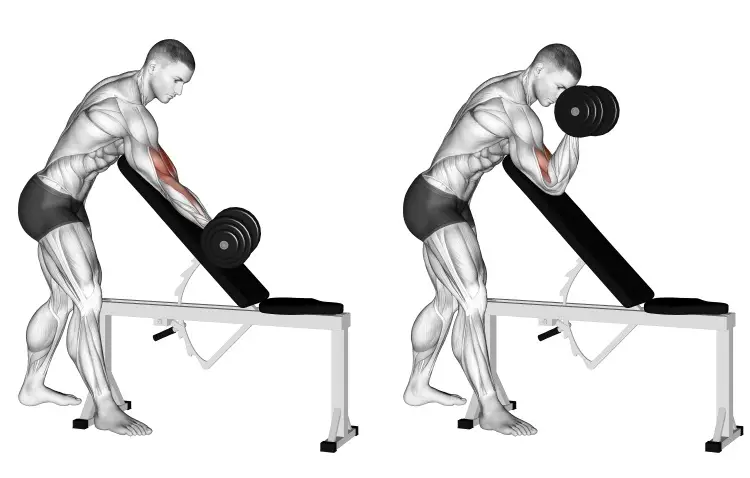
The single-arm dumbbell preacher curl is an isolation exercise that trains one biceps at a time while the upper arm rests against a preacher bench or an inclined bench. This supported position helps limit swinging and makes it easier to focus on controlled elbow flexion.
Using one dumbbell at a time also lets you train each arm independently, compare your technique from side to side, and choose a comfortable wrist position. It is a useful addition to an arm workout for beginners and experienced lifters who want to develop their biceps with strict form.
In this guide, you will learn how to perform the single-arm dumbbell preacher curl, which muscles it works, its main benefits, common mistakes to avoid, recommended sets and reps, and effective alternatives.
Table of Contents
What Is the Single-Arm Dumbbell Preacher Curl?
The single-arm dumbbell preacher curl is a unilateral biceps exercise performed with one dumbbell and a preacher bench or suitable inclined bench. You place the back of your upper arm against the pad and bend your elbow to curl the weight toward your shoulder.
Unlike a standing dumbbell curl, the supported upper arm makes it harder to use body swing to lift the weight. It encourages a more controlled movement and helps you concentrate on the working arm.
The exercise is sometimes called the one-arm dumbbell preacher curl. For a two-arm variation and additional setup guidance, see our guide to the Dumbbell Preacher Curl.
Exercise at a glance
- Primary muscle: Biceps brachii
- Assisting muscles: Brachialis and forearm muscles involved in gripping and controlling the dumbbell
- Equipment: One dumbbell and a preacher bench or suitable incline bench
- Exercise type: Single-joint isolation exercise
- Movement pattern: Elbow flexion
- Training level: Beginner to advanced, provided the weight and range of motion suit the individual
- General working range: 8–15 repetitions per arm
Muscles Worked in the Single-Arm Dumbbell Preacher Curl
1. Biceps Brachii
The biceps brachii is the primary target muscle. It helps bend the elbow and rotate the forearm so the palm faces upward.
During the preacher curl, the upper arm remains supported while the forearm moves toward the shoulder. This allows you to focus on the biceps without relying on a large amount of body momentum.
The biceps has two heads, commonly called the long head and short head. Both contribute to elbow flexion. The preacher position changes the shoulder and upper-arm position, but it should not be treated as a way to completely isolate one head.
2. Brachialis
The brachialis lies underneath the biceps and contributes to elbow flexion. It assists in raising the dumbbell regardless of whether you are performing a preacher curl or another curling variation.
Developing the brachialis can contribute to overall upper-arm thickness, although the exercise does not isolate it completely.
3. Forearm Muscles
The forearm muscles help maintain your grip and control the dumbbell. The muscles involved vary with your wrist position and how you hold the weight.
With a palm-up grip, the biceps contributes to both elbow flexion and forearm supination. Keeping your wrist aligned with your forearm helps you control the dumbbell without unnecessary wrist movement.
How to Do the Single-Arm Dumbbell Preacher Curl
Follow these steps to perform each repetition with control.
Step 1: Adjust the Bench
Set up at a preacher curl bench and adjust the seat so your working upper arm can rest comfortably against the pad. Your shoulder should remain relaxed, and you should not need to shrug or reach excessively to maintain contact.
If you do not have a preacher bench, you can use a stable incline bench. Position yourself so the back of your upper arm is supported against the inclined backrest.
Step 2: Grip the Dumbbell
Hold a dumbbell in your working hand with your palm facing forward or upward. Keep your wrist in a comfortable, neutral alignment rather than allowing it to bend backward.
Rest your upper arm against the pad, with the elbow comfortably supported. Use your free hand to hold the bench or stabilize your position if needed.
Step 3: Establish the Starting Position
Begin with your working arm extended toward the floor, allowing a comfortable stretch in the biceps. Do not force the elbow into a locked or hyperextended position.
Keep your chest stable, your shoulder relaxed, and your upper arm in contact with the pad.
Step 4: Curl the Dumbbell Up
Bend your elbow and curl the dumbbell toward your shoulder in a smooth arc. Keep the upper arm supported rather than lifting your elbow to help move the weight.
Move only as far as you can while maintaining control and a comfortable wrist position. Exhale naturally as you lift.
Step 5: Squeeze at the Top
At the top of the movement, briefly contract your biceps without shrugging your shoulder or forcing the dumbbell higher than your comfortable range allows.
A short pause can help you avoid rushing through the repetition, but an exaggerated squeeze is not essential.
Step 6: Lower the Dumbbell Slowly
Lower the dumbbell toward the starting position under control. Allow your elbow to extend naturally while keeping the upper arm supported.
Avoid dropping the weight or bouncing out of the bottom position. Once you reach a comfortable stretch, begin the next repetition.
Step 7: Complete the Other Arm
Finish the planned repetitions on one side, then switch arms. Use the same range of motion and technique on both sides, and let the weaker side guide your repetitions when the goal is balanced training.
For a visual demonstration of the movement, see the Single-Arm Dumbbell Preacher Curl exercise guide from Catalyst Athletics.
Key Form Tips for Better Repetitions
Use these cues to keep the exercise controlled and focused on the biceps.
- Keep your upper arm supported: Avoid lifting your elbow off the pad as you curl.
- Choose a manageable weight: The dumbbell should move smoothly without swinging or twisting your torso.
- Keep your wrist aligned: Avoid excessive wrist bending to help lift the weight.
- Control the lowering phase: Resist gravity instead of letting the dumbbell drop.
- Use a comfortable range of motion: Lower until your arm is comfortably extended, not until your elbow is forced into an extreme position.
- Keep your shoulder relaxed: Do not shrug or roll your shoulder forward to complete a repetition.
- Train both sides consistently: Use comparable technique and range of motion on each arm.
The goal is not to lift the heaviest dumbbell possible. It is to challenge the biceps while maintaining a repeatable, controlled movement.
Benefits of the Single-Arm Dumbbell Preacher Curl
1. Focuses on the Biceps
The preacher pad supports the upper arm and reduces the opportunity to use body momentum. This makes the exercise useful when you want a strict biceps movement at the end of an upper-body or arm workout.
2. Trains Each Arm Independently
Because each arm works separately, you can observe differences in strength, coordination, and control between your left and right sides.
If one arm completes fewer clean repetitions, use that side to set the repetition target rather than forcing the stronger arm to do extra work.
3. Helps Limit Body Swing
The supported position makes it more difficult to swing the torso to move the dumbbell. This encourages better control and makes it easier to notice when the weight is too heavy.
The bench does not automatically guarantee perfect technique, so keep your shoulder and upper arm in position throughout each repetition.
4. Allows Individual Wrist Positioning
A dumbbell gives your working hand more freedom than a fixed bar. You can use a palm-up grip and make small adjustments to find a comfortable wrist position.
Do not force your wrist to rotate or supinate farther than feels natural.
5. Makes Progress Easy to Track
You can record the weight, repetitions, and sets completed by each arm. Over time, aim to perform more controlled repetitions or increase the dumbbell weight gradually while maintaining the same technique.
6. Works Well in a Focused Arm Workout
The exercise can complement compound pulling movements and other curls. It is especially useful when you want additional direct biceps work without needing a barbell or cable machine.
Common Single-Arm Dumbbell Preacher Curl Mistakes
| Mistake | Why It Matters | How to Fix It |
|---|---|---|
| Using a dumbbell that is too heavy | Encourages swinging, shoulder movement, and shortened repetitions | Reduce the weight until you can maintain control |
| Lifting the upper arm off the pad | Allows more shoulder movement and changes the exercise | Keep the upper arm supported throughout the repetition |
| Dropping the dumbbell quickly | Reduces control during the lowering phase | Lower the weight smoothly rather than letting gravity take over |
| Forcing the elbow straight | Can cause discomfort, especially under load | Stop at a comfortable extension without snapping the elbow straight |
| Bending the wrist excessively | Makes the grip less stable and may irritate the wrist | Keep the wrist comfortably aligned with the forearm |
| Twisting the torso | Can introduce momentum and uneven technique | Keep your body stable and use a lighter weight if needed |
| Using different standards for each arm | Makes side-to-side progress harder to assess | Match your range of motion and control on both sides |
A useful rule is to end the set when you can no longer perform clean repetitions. Do not compensate for fatigue by swinging the dumbbell or lifting your shoulder.
Best Sets and Reps for the Single-Arm Dumbbell Preacher Curl
Your ideal training volume depends on your experience, goals, and the rest of your workout. Catalyst Athletics lists 8–15 repetitions as a general programming range for this exercise.
| Goal | Sets | Reps per arm | Main focus |
|---|---|---|---|
| Learning the movement | 2–3 | 10–15 | Comfortable range of motion and control |
| Muscle growth | 3–4 | 8–15 | Challenging, technically sound repetitions |
| General arm training | 2–3 | 10–15 | Consistency and gradual progression |
These are practical starting points, not mandatory prescriptions. Begin with fewer sets if you are new to resistance training or already perform substantial biceps work elsewhere in your program.
How Much Rest Should You Take?
Rest long enough to maintain good technique on the next set. Around 60–120 seconds is a practical starting point for many people performing moderate-repetition isolation work. Take longer if you are still breathing heavily or your performance has not recovered.
How Often Should You Train Biceps?
For many lifters, direct biceps training once or twice per week is a reasonable starting point. Your ideal frequency depends on your total training volume, recovery, and how much work your biceps already perform during rows, pulldowns, and other pulling exercises.
Avoid adding more sets simply because the muscles feel fresh. Track your performance and adjust your workload according to progress and recovery.
How to Progress Over Time
Use a simple progression method:
- Choose a weight that allows clean repetitions within your target range.
- Record the weight and repetitions for each arm.
- Gradually increase repetitions while preserving the same technique.
- When you can complete the upper end of the range across your planned sets with good control, consider a small weight increase.
- Return to the lower end of the repetition range and build up again.
If increasing the weight causes you to swing, shorten the movement, or lose upper-arm support, return to the previous load.
Single-Arm Dumbbell Preacher Curl Variations
1. Two-Arm Dumbbell Preacher Curl
Perform the movement with a dumbbell in each hand, provided your bench and setup allow both arms to be supported comfortably. This variation trains both arms during the same set, while the single-arm version makes it easier to concentrate on one side at a time.
Read our guide to the Dumbbell Preacher Curl for more details.
2. Barbell Preacher Curl
The barbell preacher curl uses a bar instead of a dumbbell. Both arms work together, and the bar fixes your hand position. Some lifters prefer an EZ-bar attachment if a straight bar feels uncomfortable on their wrists.
See our complete guide to the Barbell Preacher Curl for its technique, benefits, and alternatives.
3. Neutral-Grip Dumbbell Preacher Curl
In this variation, keep your palm facing inward rather than fully upward. The neutral grip changes how your forearm is positioned and may feel more comfortable for some lifters.
Use a light enough weight to keep your upper arm supported and your wrist aligned. This is a variation, not a way to eliminate all elbow or wrist stress.
4. Pronated-Grip Dumbbell Preacher Curl
Hold the dumbbell with your palm facing downward. This changes the contribution of the forearm muscles and makes the movement different from the standard palm-up preacher curl.
Start lighter than you would with your usual grip because the variation may feel less familiar.
5. Incline-Bench Single-Arm Preacher Curl
If you do not have a dedicated preacher bench, use a stable incline bench as an alternative support. Position your upper arm against the backrest so you can curl without lifting your shoulder or rotating your torso.
Adjust your body position before adding weight. If you cannot maintain comfortable upper-arm support, choose another curl variation.
Single-Arm Dumbbell Preacher Curl vs. Regular Dumbbell Curl
Both exercises train the biceps, but their setups and practical advantages differ.
| Feature | Single-Arm Dumbbell Preacher Curl | Standing Dumbbell Curl |
|---|---|---|
| Upper-arm support | Upper arm rests against a pad or backrest | Arms are unsupported |
| Body movement | More restricted when performed correctly | Greater opportunity to use body momentum |
| Training style | Strict, unilateral isolation | Flexible standing curl |
| Wrist positioning | Dumbbell allows individual hand positioning | Dumbbell allows individual hand positioning |
| Main advantage | Focus on one arm with upper-arm support | Simple setup and easy use in many workouts |
| Equipment | Dumbbell and suitable support | Dumbbell |
Neither exercise is universally better. The preacher curl is useful when you want supported, strict elbow flexion, while standing curls offer a simpler setup and allow more freedom of movement.
You can include both in a broader biceps program if the total training volume fits your goals and recovery.
Alternatives to the Single-Arm Dumbbell Preacher Curl
Choose an alternative based on the equipment you have available, your comfort, and your training goals.
- Barbell Curl: A standing curl that allows both arms to work together and makes it straightforward to track total load.
- Dumbbell Curl: A versatile option that lets each arm move independently without requiring a preacher bench.
- Cable Curl: Provides resistance through a cable system and can be performed with different handles and stances.
- Concentration Curl: Supports the working elbow against the inner thigh, making it a useful alternative when you do not have a preacher bench.
- Hammer Curl: Uses a neutral grip and trains the elbow flexors, including the brachialis and brachioradialis, alongside the biceps.
Choose one or two variations that complement your overall routine rather than performing every curl variation in the same session.
Safety Tips
The preacher position supports the upper arm, but it does not remove all stress from the elbow or wrist. Use these precautions to make the exercise more manageable.
- Start with a light dumbbell and practice the movement before increasing the load.
- Adjust the bench so you can keep your upper arm supported without reaching or shrugging.
- Avoid bouncing at the bottom of the repetition.
- Do not force your elbow into hyperextension or push through sharp joint pain.
- Keep your wrist in a comfortable position and avoid unnecessary twisting.
- Stop the set if you cannot control the weight or maintain your setup.
- If you have an existing elbow, wrist, or shoulder injury, or the movement consistently causes pain, seek guidance from a qualified healthcare professional before continuing.
Normal muscular effort is expected during training. Sharp, persistent, or worsening joint pain should not be treated as a sign that the exercise is working.
Frequently Asked Questions
Is the single-arm dumbbell preacher curl good for building biceps?
Yes. It is a useful biceps isolation exercise because the upper arm is supported and each side works independently. Results depend on consistent training, appropriate effort, adequate recovery, and progressive overload over time.
What muscles does the single-arm dumbbell preacher curl work?
The biceps brachii is the primary target. The brachialis assists with elbow flexion, while forearm muscles help grip and control the dumbbell.
How many reps should I do?
A general starting range is 8–15 repetitions per arm. Use a weight that allows controlled repetitions through a comfortable range of motion.
Should I fully straighten my arm at the bottom?
Lower the dumbbell until your elbow is comfortably extended, but do not force it into a locked or hyperextended position. If full extension is uncomfortable, shorten the range slightly and use a load you can control.
Should I train one arm at a time?
Yes. The single-arm setup allows you to focus on one side and compare technique between arms. Complete the same planned number of clean repetitions on both sides, adjusting the load if necessary.
Is the preacher curl better than the standing dumbbell curl?
They serve slightly different purposes. The preacher curl supports the upper arm and helps limit swinging, while the standing curl requires less equipment and allows more freedom of movement. Both can be effective when performed consistently.
Can beginners perform this exercise?
Yes, beginners can learn it with a light dumbbell, a stable bench, and a comfortable range of motion. Focus on keeping the upper arm supported before trying to lift heavier weights.
How heavy should the dumbbell be?
Choose a weight that lets you complete your target repetitions without swinging your body, lifting your elbow off the pad, or forcing your wrist into an uncomfortable position. Increase the load gradually as your control improves.
Can I perform this exercise without a preacher bench?
Yes. A stable incline bench can provide a similar upper-arm support position. You can also choose concentration curls or regular dumbbell curls if you cannot find a comfortable and secure setup.
Should I do preacher curls before or after other biceps exercises?
That depends on your workout priorities. Perform them earlier if strict preacher-curl performance is a priority, or later if you prefer to do larger compound pulling exercises first. Keep the overall workload manageable.
Key Takeaways
The single-arm dumbbell preacher curl is a practical exercise for focused biceps training. Supporting the upper arm helps limit swinging, while using one dumbbell at a time lets you concentrate on each side independently.
For effective repetitions, keep your upper arm supported, use a comfortable range of motion, control the lowering phase, and choose a weight that allows consistent technique. Start with 2–3 sets of 10–15 repetitions if you are learning the movement, or use 3–4 sets of 8–15 repetitions as a general muscle-building starting point.
Progress gradually, train both arms consistently, and adjust the exercise if it causes joint pain. Combine it with a balanced resistance-training program for long-term strength and muscle development.