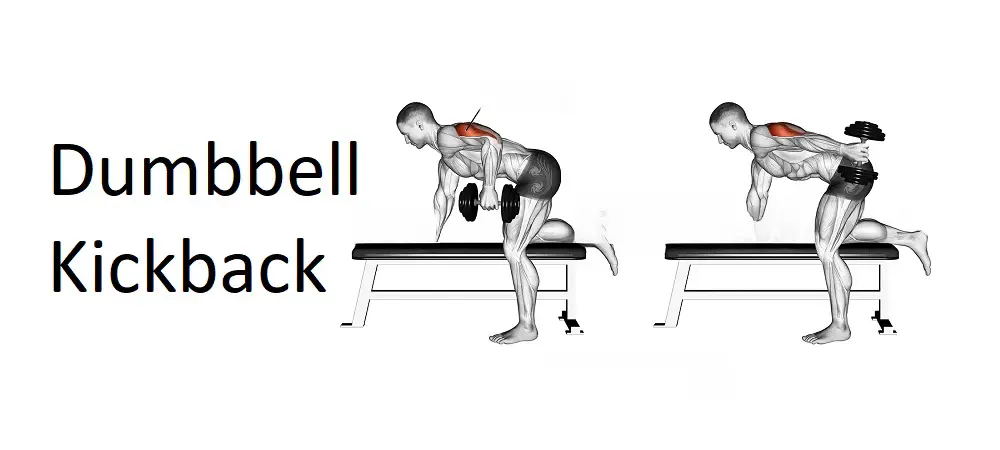
The dumbbell kickback is an isolation exercise that targets the triceps, the muscles at the back of your upper arms. It involves extending your elbow to move a dumbbell backward while keeping your upper arm relatively still.
Because the exercise uses a controlled, single-joint movement, it is often included near the end of an upper-body or arm workout. You do not need heavy dumbbells to perform it effectively; choosing a manageable weight helps you maintain good technique.
In this guide, you will learn how to perform the dumbbell kickback with proper form, which muscles it works, its benefits, common mistakes, variations, and how to include it in your training routine.
Table of Contents
What Is a Dumbbell Kickback?
A dumbbell kickback is a triceps exercise performed while leaning forward and extending your elbow against resistance. You hold a dumbbell with your elbow bent, keep your upper arm close to your torso, and straighten your arm behind you.
The main movement happens at the elbow. Your shoulder and torso should remain stable instead of swinging the weight backward.
Dumbbell kickbacks can be performed with one arm at a time, using your free hand for support, or with both arms together if you can maintain a stable position.
Muscles Worked by the Dumbbell Kickback
1. Triceps Brachii
The triceps brachii is the primary muscle group targeted by the dumbbell kickback. It has three heads: the long head, lateral head, and medial head. These work together to extend the elbow.
Keeping your upper arm stable and controlling the extension helps you focus on the triceps rather than using momentum.
2. Rear Deltoids and Shoulder Stabilizers
The rear deltoids and other shoulder muscles help maintain the position of your upper arm. They should stabilize the movement rather than drive the dumbbell backward.
3. Core and Back Muscles
Your core and back muscles help keep your torso stable while you lean forward. They support your posture but are not the primary targets of the exercise.
Benefits of the Dumbbell Kickback
1. Direct Triceps Training
Dumbbell kickbacks provide direct work for the elbow extensors. They can complement compound pushing exercises such as presses and push-ups.
2. Simple Equipment Requirements
You need only a dumbbell and enough space to lean forward safely. A bench can also provide support and make the setup more comfortable.
3. Independent Arm Training
Performing the exercise one arm at a time lets you concentrate on each side separately. It may also help you notice differences in control or comfortable range of motion.
4. Useful for Finishing an Arm Workout
Because kickbacks are an isolation exercise, they can fit near the end of a triceps session after larger movements. They do not need to replace compound exercises in a balanced program.
5. Easy to Adjust
You can reduce the weight, use a supported stance, or perform one arm at a time to make the exercise easier to control. Progress gradually as your technique improves.
How to Do the Dumbbell Kickback With Proper Form
Step 1: Choose Your Dumbbell
Select a light weight that you can control throughout the movement. A dumbbell that is too heavy can cause you to swing your arm or rotate your torso.
Step 2: Set Your Stance
Stand with your feet in a comfortable staggered stance and bend slightly at your knees. Hinge forward at your hips while keeping your back in a neutral position.
You can place your free hand on a stable bench for support when performing a single-arm kickback.
Step 3: Hold the Dumbbell
Grip the dumbbell with your palm facing your torso. Keep your wrist aligned with your forearm instead of allowing it to bend backward.
Step 4: Position Your Upper Arm
Bring your working upper arm close to your torso, approximately parallel to the floor if that position is comfortable. Bend your elbow so your forearm hangs downward.
Keep your shoulder relaxed and your torso steady.
Step 5: Extend Your Elbow
Straighten your elbow to move the dumbbell backward. Keep your upper arm in roughly the same position instead of swinging the entire arm from the shoulder.
Exhale as you extend your elbow.
Step 6: Pause at the Top
When your arm is comfortably straight, pause briefly and contract your triceps. Do not force your elbow beyond its natural range of motion.
Step 7: Return Slowly
Bend your elbow to bring the dumbbell back to the starting position. Control the descent rather than allowing the weight to drop.
Step 8: Complete Your Repetitions
Perform the planned repetitions with consistent technique, then switch arms if you are using the single-arm variation.
If your torso begins rotating or your upper arm repeatedly moves, reduce the weight.
Dumbbell Kickback Form Tips
- Keep your upper arm stable: The main movement should occur at the elbow.
- Maintain a neutral back: Hinge at the hips without rounding or excessively arching your lower back.
- Use a manageable weight: Light dumbbells are often sufficient for controlled repetitions.
- Keep your wrist aligned: Avoid bending your wrist to move the weight.
- Control both phases: Extend the elbow smoothly and lower the dumbbell under control.
- Avoid shoulder swinging: Do not use your entire arm to throw the weight backward.
- Use a comfortable range: Straighten your elbow without forcing a painful lockout.
For another professional technique reference, see the American Council on Exercise’s Triceps Kickback exercise guide.
Common Dumbbell Kickback Mistakes to Avoid
1. Using Too Much Weight
Heavy dumbbells can cause swinging, shoulder movement, or torso rotation.
How to fix it: Reduce the load until you can extend your elbow without using momentum.
2. Moving the Upper Arm Too Much
Allowing your upper arm to swing backward and forward changes the exercise and makes it harder to control the movement.
How to fix it: Keep your upper arm close to your torso and focus on extending the elbow.
3. Rushing the Repetitions
Moving too quickly can reduce control, particularly during the lowering phase.
How to fix it: Use a smooth lifting motion, pause briefly at the top, and lower the dumbbell deliberately.
4. Rounding the Back
An unstable or excessively rounded position can make the bent-over setup uncomfortable.
How to fix it: Hinge at the hips, brace your core, and choose a supported position if needed.
5. Rotating the Torso
Twisting your body to finish repetitions uses momentum instead of maintaining a consistent movement.
How to fix it: Keep your chest and hips steady. Use a bench for support or reduce the weight.
6. Forcing the Elbow Straight
Trying to push the dumbbell beyond a comfortable end position can irritate the elbow.
How to fix it: Extend your arm through a controlled, comfortable range without forcing the joint.
Dumbbell Kickback Variations
1. Single-Arm Dumbbell Kickback
Perform the exercise with one arm while supporting your free hand on a stable bench or your front thigh. This setup can make it easier to stabilize your torso and focus on the working arm.
2. Two-Arm Dumbbell Kickback
Hold a dumbbell in each hand and perform the movement simultaneously. This variation requires you to stabilize your torso without the support of a free hand.
3. Incline Bench Dumbbell Kickback
Lie chest-down on an incline bench with your arms hanging naturally. Keep your upper arms stable and extend your elbows to move the dumbbells backward.
Adjust the bench and weight so the movement remains comfortable.
4. Cable Triceps Kickback
Use a single handle attached to a low cable pulley. The cable provides resistance through a different loading pattern from dumbbells.
5. Resistance Band Kickback
Anchor a resistance band securely and perform the same elbow-extension movement. Check that the band and anchor are stable before beginning.
Dumbbell Kickback vs. Cable Triceps Extension
Both exercises train the triceps, but they use different equipment and movement setups.
| Feature | Dumbbell Kickback | Cable Triceps Extension |
|---|---|---|
| Equipment | Dumbbell | Cable machine and attachment |
| Main movement | Elbow extension with the upper arm held behind the torso | Elbow extension against cable resistance |
| Setup | Requires a stable bent-over position | Depends on the cable attachment and exercise variation |
| Resistance | Changes with the dumbbell’s position relative to gravity | Follows the cable’s line of pull |
| Best use | Triceps isolation with simple equipment | Triceps isolation with adjustable cable resistance |
Neither exercise is automatically better. Choose the version that feels comfortable and allows you to maintain controlled repetitions.
You can explore SaveDollar’s Cable Triceps Extension and Cable One Arm Pushdown guides for additional triceps exercises.
Sets and Reps for Dumbbell Kickbacks
Your training volume should fit your experience, recovery, and the other exercises in your workout.
- Beginners: Start with 2 sets of 10–15 repetitions per arm using a light dumbbell.
- Intermediate trainees: Try 2–3 sets of 10–15 repetitions per arm while maintaining consistent form.
- Rest periods: Begin with approximately 60–90 seconds between sets and rest longer if needed.
These are starting guidelines, not strict rules. Increase resistance gradually only when you can complete your repetitions without swinging or changing your posture.
How to Include Dumbbell Kickbacks in a Triceps Workout
A simple example session could include:
- Close-Grip Bench Press – 3 sets of 8–10 repetitions.
- Cable Triceps Extension – 3 sets of 10–15 repetitions.
- Dumbbell Kickback – 2 sets of 10–15 repetitions per arm.
This is an example rather than a required routine. Adjust the exercises and total sets according to your training experience, goals, and recovery.
Safety Considerations
- Use a stable stance or bench support when needed.
- Choose a weight you can control throughout the movement.
- Keep your back in a comfortable, neutral position.
- Do not force your elbow into an uncomfortable end position.
- Stop if you experience sharp pain or unusual symptoms.
- If you have an existing elbow, shoulder, or back injury, seek qualified advice before adding the exercise to your routine.
Frequently Asked Questions
What Muscles Do Dumbbell Kickbacks Work?
Dumbbell kickbacks primarily target the triceps brachii, which extends the elbow. The shoulder stabilizers and core muscles help maintain your position.
Are Dumbbell Kickbacks Good for Beginners?
They can be suitable for beginners who start with light dumbbells and learn to keep their upper arms stable. Using a bench for support can make the setup easier to control.
How Heavy Should My Dumbbells Be?
Choose a weight that lets you complete each repetition without swinging your torso or moving your upper arm excessively. Increase the load gradually as your technique improves.
Are Dumbbell Kickbacks Better Than Pushdowns?
Neither is universally better. Both train the triceps, but the resistance and setup differ. Choose the exercise that feels comfortable and fits your equipment and training program.
How Many Sets and Reps Should I Do?
A reasonable starting point is 2–3 sets of 10–15 repetitions per arm. Adjust the volume based on your overall triceps training and recovery.
Should I Fully Straighten My Arm?
Extend your elbow through a comfortable, controlled range. Avoid forcing the joint beyond its natural position or locking it aggressively under load.
How Often Should I Train Triceps?
Many training programs include direct triceps work once or twice a week, depending on total volume and recovery. Remember that pressing exercises also train the triceps.
Key Takeaways
The dumbbell kickback is an isolation exercise that targets the triceps through controlled elbow extension. It requires little equipment and can complement compound pressing movements in a balanced upper-body program.
Use a manageable weight, keep your upper arm stable, maintain a comfortable bent-over position, and control the return phase. Focus on consistent technique rather than lifting heavier dumbbells at the expense of form.