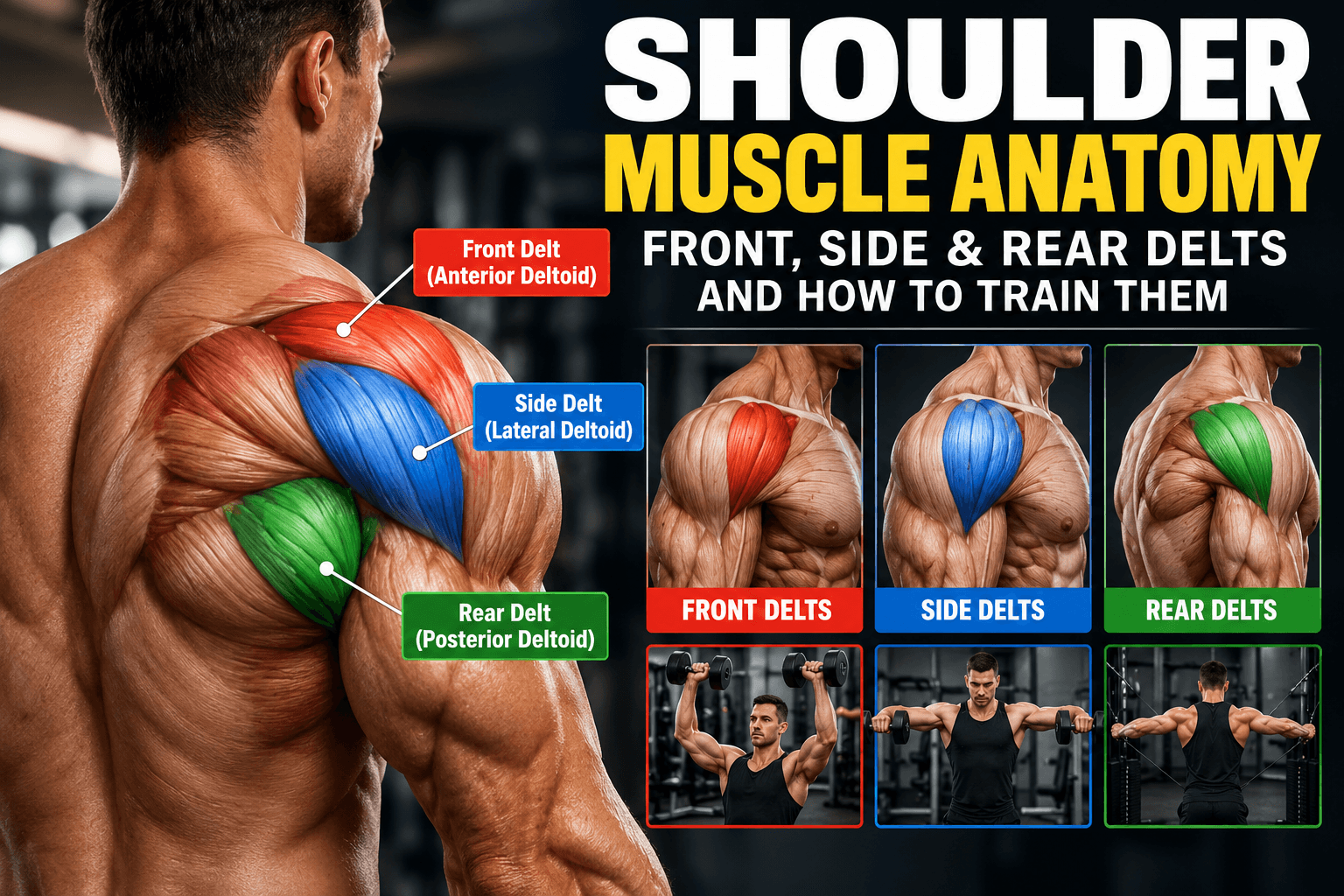
The incline dumbbell front raise is a shoulder isolation exercise performed face down on an inclined bench while raising dumbbells forward in a controlled arc. The chest-supported position helps limit body swing and makes it easier to focus on the front of the shoulders, also known as the anterior deltoids.
This guide explains how to perform the incline dumbbell front raise, which muscles it trains, how to choose a suitable weight, common mistakes to avoid, and how to include it in a shoulder workout.
Table of Contents
Incline Dumbbell Front Raise: Quick Overview
| Exercise detail | Information |
|---|---|
| Primary muscle | Anterior deltoid, or front shoulder |
| Secondary muscles | Lateral deltoid and other muscles that assist or stabilize the movement |
| Equipment | Incline bench and a pair of dumbbells |
| Exercise type | Isolation exercise |
| Difficulty | Beginner friendly when performed with light weights and controlled technique |
| Main movement | Shoulder flexion |
| Best use | Accessory shoulder training |
What Muscles Does the Incline Dumbbell Front Raise Work?
1. Anterior deltoid
The anterior deltoid is the main target. It helps lift the upper arm forward, which is the primary movement in a front raise. The incline position allows you to train this movement while your chest is supported by the bench.
2. Lateral deltoid
The lateral, or side, deltoid may contribute when the arms travel slightly outward rather than directly forward. However, the incline dumbbell front raise is primarily a front-delt exercise, not a replacement for a lateral raise.
3. Upper chest and other assisting muscles
The clavicular portion of the pectoralis major can assist with shoulder flexion. Muscles around the shoulder blade also help coordinate and stabilize the movement. Their contribution depends on your arm path, grip, range of motion, and individual technique.
The main training emphasis remains the anterior deltoid. The exercise should not be described as an equal workout for every shoulder muscle.
How to Do the Incline Dumbbell Front Raise
Equipment and setup
- Set an adjustable bench to approximately 30 to 45 degrees as a practical starting point.
- Place a light dumbbell beside each side of the bench so you can pick them up safely.
- Lie face down with your chest supported by the pad. Keep your feet firmly on the floor for stability.
- Allow your arms to hang toward the floor with a dumbbell in each hand.
- Begin with a neutral grip, meaning your palms face each other, and keep a slight bend in your elbows.
- Brace your midsection gently and keep your neck comfortable rather than lifting your head to look forward.
Choose a bench angle that allows your arms to move freely without the dumbbells striking the bench, floor, or your legs.
Execution
- Start from a controlled hang. Let the dumbbells hang below your shoulders without allowing your shoulders to pull uncomfortably forward.
- Raise the dumbbells forward. Lift both arms in a smooth arc in front of your body. Keep the elbow bend nearly constant throughout the repetition.
- Stop at a comfortable height. Raise until your upper arms are approximately in line with your torso, or earlier if you experience discomfort. You do not need to lift as high as possible.
- Pause briefly. Maintain control without shrugging or forcing your shoulders into an uncomfortable position.
- Lower slowly. Return the dumbbells to the hanging position over roughly two to three seconds.
- Repeat. Complete your planned repetitions without swinging or bouncing the weights.
Exhale as you raise the dumbbells and inhale as you lower them. Use a comfortable breathing rhythm rather than holding your breath throughout the set.
Form Tips for Better Repetitions
- Use a manageable load. This is an isolation exercise, so very heavy dumbbells are rarely necessary for learning the movement.
- Keep your chest supported. Avoid lifting your chest off the bench to gain extra range.
- Maintain a slight elbow bend. Do not repeatedly bend and straighten your elbows during each repetition.
- Move with control. Lift smoothly and resist gravity as you lower the dumbbells.
- Keep your wrists comfortable. Avoid forcing them into an excessively bent position.
- Use a repeatable range of motion. Stop at a height you can control without shrugging, swinging, or discomfort.
- Adjust the grip if needed. A neutral grip is a practical starting option. A pronated, or palms-down, grip may also be comfortable for some people, provided the dumbbells clear the bench and legs.
The goal is consistent shoulder movement, not the heaviest weight or the highest possible lift.
Common Incline Dumbbell Front Raise Mistakes
| Mistake | Why it is a problem | How to correct it |
|---|---|---|
| Using dumbbells that are too heavy | Encourages swinging and loss of control | Reduce the load until every repetition is smooth |
| Lifting the chest off the bench | Allows extra body movement to assist the lift | Keep the chest supported and shorten the range if needed |
| Shrugging the shoulders | Changes the movement and may reduce the intended emphasis | Use a lighter load and keep the neck relaxed |
| Locking the elbows rigidly | Can make the movement uncomfortable and difficult to control | Maintain a small, consistent bend |
| Raising much higher than necessary | May encourage shrugging or compensatory movement | Stop around the point where the upper arms align with the torso, if comfortable |
| Dropping the weights quickly | Reduces control during the lowering phase | Lower the dumbbells deliberately |
| Forcing an uncomfortable grip | May irritate the shoulder or wrist | Try a neutral grip or adjust the setup |
If you cannot perform repetitions without swinging or losing your position, reduce the weight before continuing.
Benefits of the Incline Dumbbell Front Raise
Focused front-shoulder training
The movement directly trains shoulder flexion, with the anterior deltoid as the primary target. It can be useful when front-shoulder development is a specific goal.
Less opportunity to swing the torso
Supporting your chest against the bench limits the ability to rock backward and use body momentum. It does not eliminate momentum automatically, so controlled repetitions are still important.
Adjustable range and grip
You can adjust the bench angle, grip, and range of motion to find a repeatable position that feels comfortable. Make one adjustment at a time so you can tell whether it improves the movement.
An accessory option for shoulder workouts
The exercise can complement a broader shoulder program. It is not essential for everyone, particularly people who already perform substantial pressing work that trains the anterior deltoids.
Sets, Reps, and Weight Recommendations
The right amount of work depends on your training experience, goals, and the rest of your program. Use the following as a starting point rather than a mandatory prescription.
| Goal | Suggested starting point | Guidance |
|---|---|---|
| Learning the movement | 1 to 2 sets of 10 to 15 reps | Use a light load and focus on control |
| General muscle growth | 2 to 3 sets of 10 to 15 reps | Choose a load that allows consistent technique |
| Shoulder accessory work | 2 to 3 sets of 12 to 20 reps | Keep the repetitions controlled and stop before technique breaks down |
Rest for around 60 to 120 seconds between sets, adjusting the rest period to your effort and recovery.
How to choose the weight
Start lighter than you think you need. The correct weight allows you to raise and lower the dumbbells without swinging, shrugging, lifting your chest, or experiencing pain.
Once you can complete all planned repetitions with consistent technique, you can gradually increase the load by the smallest practical amount or add a repetition or two. Do not increase the weight and the number of sets at the same time unless your program calls for it.
The 2026 American College of Sports Medicine resistance-training position stand emphasizes progressive training and tailoring the prescription to the goal. The set and rep ranges above are practical starting suggestions for this exercise, not a claim that one specific range is uniquely superior.
Variations and Alternatives
1. Single-arm incline dumbbell front raise
Raise one dumbbell at a time while keeping your chest supported and torso still. This can make it easier to focus on each side individually. Avoid rotating your torso to help the weight rise.
2. Neutral-grip incline front raise
Keep your palms facing each other throughout the movement. This is a straightforward grip to try if a palms-down position feels uncomfortable.
3. Standing dumbbell front raise
Perform the movement while standing, raising the dumbbells in front of your body. Because your torso is not supported by a bench, you must resist swinging and maintain a stable position.
4. Alternating dumbbell front raise
Lift one dumbbell while the other arm remains down, then alternate sides. Use a controlled tempo and avoid leaning backward as the weight rises.
5. Front plate raise
Hold a weight plate with both hands and raise it in front of your body. This provides a different grip and loading arrangement.
6. Single-arm cable front raise
A cable provides resistance through a different setup and allows you to train one arm at a time. Adjust the cable height and stance so the movement remains smooth and comfortable.
For related exercise instructions, see the SaveDollar guides to single-arm cable front raise, front plate raise, and dumbbell alternating front raise. For a broader look at exercise selection, read the guide to front delt exercises.
Safety and Precautions
Use a bench and dumbbells that are stable and appropriate for your size and experience. Pick up and put down the weights carefully, and make sure the dumbbells have enough clearance to move without hitting the bench or your legs.
Do not force the movement through a painful range. If you feel sharp pain, pinching, numbness, or unusual weakness, stop the set. If discomfort persists, seek advice from a qualified healthcare professional. If you have a current shoulder injury or are returning after surgery, ask your clinician whether this exercise is appropriate for you.
The exercise is not a treatment for shoulder injuries, and it should not be presented as a way to prevent or cure a specific condition.
Frequently Asked Questions
Is the incline dumbbell front raise good for the front delts?
Yes. The anterior deltoid is the primary muscle responsible for raising the upper arm forward. This exercise can be useful when you want to give that muscle additional direct work.
Is an incline dumbbell front raise better than a standing front raise?
Neither variation is universally better. The incline version supports your chest and limits torso movement, while the standing version requires you to stabilize your body without the bench. Choose the version that fits your goal, equipment, and comfort.
What bench angle should I use?
Start around 30 to 45 degrees and adjust if necessary. There is no need to change the angle every session. Use a position that supports your chest and allows a comfortable, controlled range of motion.
Should I keep my elbows straight?
Keep a slight bend in your elbows and maintain it throughout the repetition. Avoid rigidly locking the elbows or changing the elbow angle to swing the weights upward.
Can beginners perform this exercise?
Yes, many beginners can learn it with light dumbbells, a stable bench, and a controlled range of motion. Start with fewer sets and focus on technique before increasing the load.
How often should I perform incline dumbbell front raises?
Frequency depends on your complete shoulder program and recovery. Include the exercise only as much as needed to support your goal, taking into account the front-deltoid work you already get from presses and other exercises.
Why do I feel the exercise in my neck or upper traps?
Shrugging, excessive weight, or lifting higher than you can control may increase the contribution of the upper trapezius. Reduce the load, keep your neck relaxed, and use a comfortable range. Stop if you experience pain.
Can I use a barbell instead of dumbbells?
A barbell front raise is a separate variation, but it is not an exact replacement for the chest-supported incline version. A bar may restrict your hand position and require a different setup. Use an alternative only if you can perform it safely and comfortably.
Conclusion
The incline dumbbell front raise is a focused accessory exercise for the anterior deltoids. Set up with your chest supported, use a manageable load, keep a slight bend in your elbows, raise the dumbbells with control, and lower them slowly.
Progress gradually and include the movement only when it serves your broader shoulder-training plan. Consistent technique and an appropriate training dose matter more than lifting the heaviest dumbbells.
References
- American Council on Exercise, Front Raise Exercise Library. General front-raise technique and movement guidance.
- NCBI Bookshelf, Anatomy of the Shoulder and Upper Limb. Background on shoulder muscles and the function of the anterior deltoid.
- American College of Sports Medicine, 2026 Resistance Training Position Stand. Evidence review on resistance-training prescriptions for healthy adults.