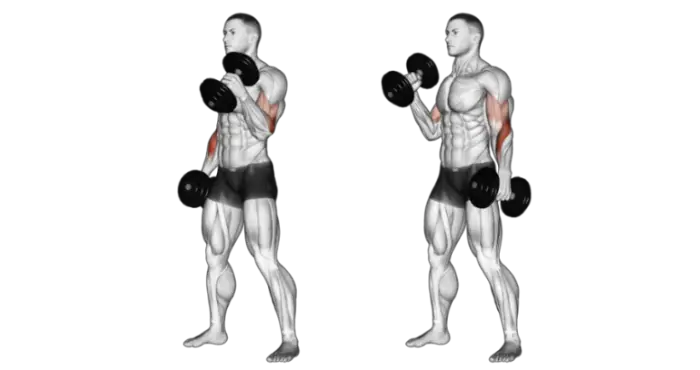
The cross-body hammer curl is a dumbbell exercise that trains the biceps, brachialis, and brachioradialis while using a neutral grip. Instead of curling the dumbbell toward the same-side shoulder like a standard hammer curl, you bring it diagonally across your body toward the opposite shoulder.
This movement is useful when you want to add variety to your arm training while working one side at a time. Keeping the palms facing inward, controlling the elbow, and avoiding torso momentum are important for maintaining proper form.
In this guide, you’ll learn how to perform the cross-body hammer curl correctly, which muscles it works, its benefits, common mistakes, variations, and how it compares with the standard hammer curl.
How to Do the Cross-Body Hammer Curl: Proper Form
Follow these steps to perform the cross-body hammer curl with controlled technique:
- Stand tall with a dumbbell in each hand. Let your arms hang naturally at your sides with your palms facing inward toward your body. Keep your chest up and torso stable.
- Keep a neutral grip throughout the movement. Your palms should continue facing inward rather than rotating upward into a traditional biceps curl.
- Curl one dumbbell diagonally across your body. Bend your elbow and bring the dumbbell toward the opposite shoulder while keeping your upper arm relatively close to your torso.
- Keep the elbow controlled. The diagonal path should come from the forearm and hand moving across the body, not from swinging the upper arm across your torso.
- Pause briefly near the top. When the dumbbell reaches the opposite shoulder area, squeeze the working arm without forcing the range of motion.
- Lower the dumbbell slowly along the same path. Control the descent until your arm is comfortably extended again rather than allowing the weight to drop.
- Repeat with the opposite arm. Alternate sides for the desired number of repetitions, or complete all repetitions on one side before switching.
Key Form Cues
- Keep your palms facing inward throughout each repetition.
- Keep your wrist neutral rather than bending it toward the palm.
- Keep your torso stable instead of leaning away from the working arm.
- Keep the elbow controlled as the dumbbell travels toward the opposite shoulder.
- Use a weight that allows you to complete the movement without swinging or shortening the range of motion.
Cross-Body Hammer Curl Muscles Worked: What Does It Target?
The cross-body hammer curl is an isolation exercise that primarily trains the biceps and elbow flexors, with significant assistance from the brachialis and brachioradialis. The neutral grip keeps the palms facing inward while the dumbbell travels diagonally toward the opposite shoulder.
Biceps
The biceps brachii helps flex the elbow during the curl. Although the neutral grip changes the mechanics compared with a traditional supinated curl, the biceps still contributes to the movement.
Brachialis
The brachialis is an important elbow flexor located underneath the biceps. It works during the cross-body hammer curl and contributes to overall upper-arm thickness.
Brachioradialis and Forearms
The brachioradialis is a major forearm muscle involved in elbow flexion, particularly when the forearm remains in a neutral position. Other forearm muscles also help stabilize the wrist and grip the dumbbell.
Does the Cross-Body Hammer Curl Work the Biceps?
Yes. The cross-body hammer curl works the biceps, but it also trains the brachialis and brachioradialis. The exercise should not be treated as a movement that isolates one specific part of the biceps. Its main value is providing a neutral-grip curl variation that trains the elbow flexors through a different movement pattern.
Common Cross-Body Hammer Curl Mistakes
Avoid these common mistakes to keep the movement controlled and maintain tension on the muscles being trained.
1. Swinging the Dumbbell
Using momentum from the hips or torso can make the weight easier to lift while reducing control of the curl.
Fix: Use a lighter dumbbell and keep your torso still throughout each repetition.
2. Letting the Elbow Move Across the Body
The hand should travel across the body, but the upper arm and elbow should remain relatively controlled. Moving the elbow toward the opposite side can change the movement and reduce the intended focus.
Fix: Keep the elbow close to its starting position while the forearm moves the dumbbell toward the opposite shoulder.
3. Rotating the Wrist During the Curl
Turning the palm upward during the repetition changes the neutral-grip position that defines the hammer curl.
Fix: Keep your palm facing inward and maintain a neutral wrist from the starting position through the lowering phase.
4. Leaning Away From the Working Arm
Leaning your torso away from the dumbbell can create extra momentum and shorten the effective range of motion.
Fix: Keep your chest and hips facing forward and let the working arm perform the curl without shifting your body.
5. Using Too Much Weight
A dumbbell that is too heavy can cause swinging, elbow movement, and loss of control during the lowering phase.
Fix: Choose a weight that allows you to complete every repetition with a controlled lift and slow descent.
6. Cutting the Lowering Phase Short
Dropping the dumbbell quickly or stopping the descent early reduces control during the eccentric portion of the exercise.
Fix: Lower the dumbbell along the same diagonal path until your arm is comfortably extended before starting the next repetition.
Cross-Body Hammer Curl Benefits
The cross-body hammer curl is a useful dumbbell curl variation for training the elbow flexors while adding a different movement path from a standard hammer curl.
1. Trains the Biceps and Brachialis
The exercise trains the biceps while also involving the brachialis, an important elbow flexor underneath the biceps. This makes it useful for building overall upper-arm strength and size.
2. Strengthens the Forearms
The neutral grip increases the involvement of the brachioradialis and other forearm muscles that help control the dumbbell and stabilize the wrist.
3. Provides a Different Curling Angle
Curling the dumbbell diagonally toward the opposite shoulder changes the movement path compared with a standard curl. This can add variety to an arm-training routine without requiring different equipment.
4. Allows Focus on One Arm at a Time
Performing the exercise one arm at a time makes it easier to concentrate on each side individually. It can also help you notice differences in control or strength between your arms.
5. Requires Minimal Equipment
All you need is a pair of dumbbells, making the cross-body hammer curl easy to include in both home and gym workouts.
6. Can Support Progressive Overload
As your technique and strength improve, you can gradually increase the dumbbell weight while maintaining controlled repetitions and proper form. The goal is to progress without sacrificing your range of motion or movement control.
Cross-Body Hammer Curl vs. Hammer Curl
The cross-body hammer curl and standard hammer curl both use a neutral grip, but the dumbbell follows a different path. In a standard hammer curl, you curl the dumbbell straight toward the same-side shoulder. In a cross-body hammer curl, you curl it diagonally toward the opposite shoulder.
| Feature | Cross-Body Hammer Curl | Hammer Curl |
|---|---|---|
| Grip | Neutral, palms facing inward | Neutral, palms facing inward |
| Curl path | Across the body toward the opposite shoulder | Straight up toward the same-side shoulder |
| Equipment | Dumbbells | Dumbbells |
| Main muscles | Biceps, brachialis, brachioradialis | Biceps, brachialis, brachioradialis |
| Movement | Usually performed one arm at a time | Can be performed with both arms or alternated |
| Best use | Adding variation and unilateral arm work | Building a simple, repeatable hammer-curl movement |
Which Is Better: Cross-Body Hammer Curl or Hammer Curl?
Neither exercise is universally better. The standard hammer curl is usually the simpler option for learning the neutral-grip curling pattern and progressively increasing weight.
The cross-body hammer curl is useful when you want to train one arm at a time and introduce a different curling path into your workout.
You can also use both exercises in the same training program. For example, standard hammer curls can be used for your main hammer-curl work, while cross-body hammer curls can provide additional variation later in the workout.
The important factor is maintaining controlled technique rather than choosing an exercise based on the idea that one variation automatically produces better results.
Cross-Body Hammer Curl FAQs
Are Cross-Body Hammer Curls Good for Beginners?
Yes. Cross-body hammer curls can be suitable for beginners because the movement uses a simple neutral grip and requires only dumbbells. Start with a light weight and focus on keeping your torso stable, your wrist neutral, and your movement controlled.
What Muscles Do Cross-Body Hammer Curls Work?
Cross-body hammer curls primarily train the elbow flexors, including the biceps, brachialis, and brachioradialis. The forearm muscles also help stabilize the wrist and maintain your grip on the dumbbell.
Can You Do Cross-Body Hammer Curls With One Dumbbell?
Yes. You can perform the exercise with one dumbbell by completing all repetitions on one arm before switching sides. This can make it easier to concentrate on each arm individually.
Should You Alternate Arms During Cross-Body Hammer Curls?
You can either alternate arms from repetition to repetition or complete one side before switching. Both approaches can work. Choose the method that allows you to maintain good posture, controlled repetitions, and a consistent range of motion.
What Is the Difference Between a Cross-Body Curl and a Hammer Curl?
Both movements can use a neutral grip, but the path is different. A standard hammer curl travels upward toward the same-side shoulder, while a cross-body hammer curl travels diagonally toward the opposite shoulder.
How Many Reps Should You Do for Cross-Body Hammer Curls?
A practical starting point is around 8–15 repetitions per arm per set. Choose a weight that allows you to maintain proper form throughout the set rather than sacrificing control to lift heavier.
Cross-Body Hammer Curl Variations
Once you are comfortable with the standard cross-body hammer curl, you can change the setup or equipment to add variety to your arm training.
Hammer Curl
The Hammer Curl uses the same neutral grip but curls the dumbbell toward the same-side shoulder instead of across the body. It is a straightforward option when you want to train the elbow flexors with a standard hammer-curl movement.
Alternate Hammer Curl
The Alternate Hammer Curl allows you to work one arm at a time while keeping the neutral hammer-curl grip. This can be useful when you want to concentrate on each arm individually.
Cable Rope Hammer Curl
The Cable Rope Hammer Curl provides a cable-based alternative to dumbbell hammer curls. The rope allows the hands to maintain a neutral position while the cable provides resistance throughout the movement.
Single-Arm Cross-Body Hammer Curl
Perform the cross-body hammer curl with one dumbbell at a time instead of holding two dumbbells. This allows you to concentrate on one arm and can make it easier to maintain consistent form.
Seated Cross-Body Hammer Curl
Perform the exercise while seated on a bench. The seated position can help reduce unnecessary torso movement and make it easier to concentrate on controlled elbow flexion.
Alternating Cross-Body Hammer Curl
Alternate between your left and right arms from repetition to repetition. This allows one arm to rest briefly while the other performs the movement and can make it easier to maintain consistent technique.
Related Hammer Curl Exercises
If you want to explore other dumbbell and cable exercises for your biceps and forearms, these related movements are worth considering:
- Preacher Hammer Dumbbell Curl — uses a preacher bench to provide upper-arm support while maintaining a hammer-style grip.
- Palms-Out Incline Biceps Curl — provides a different biceps-focused movement using an incline setup and palms-out position.
Conclusion
The cross-body hammer curl is a useful dumbbell exercise for training the biceps, brachialis, and brachioradialis with a neutral grip. Curling the dumbbell toward the opposite shoulder gives you a different movement path from the standard hammer curl while allowing you to work one arm at a time.
For the best results, use a weight you can control, keep your wrist neutral, avoid swinging your torso, and control both the lifting and lowering phases. You can use the cross-body hammer curl alongside standard hammer curls and other biceps exercises to add variety to your arm training.