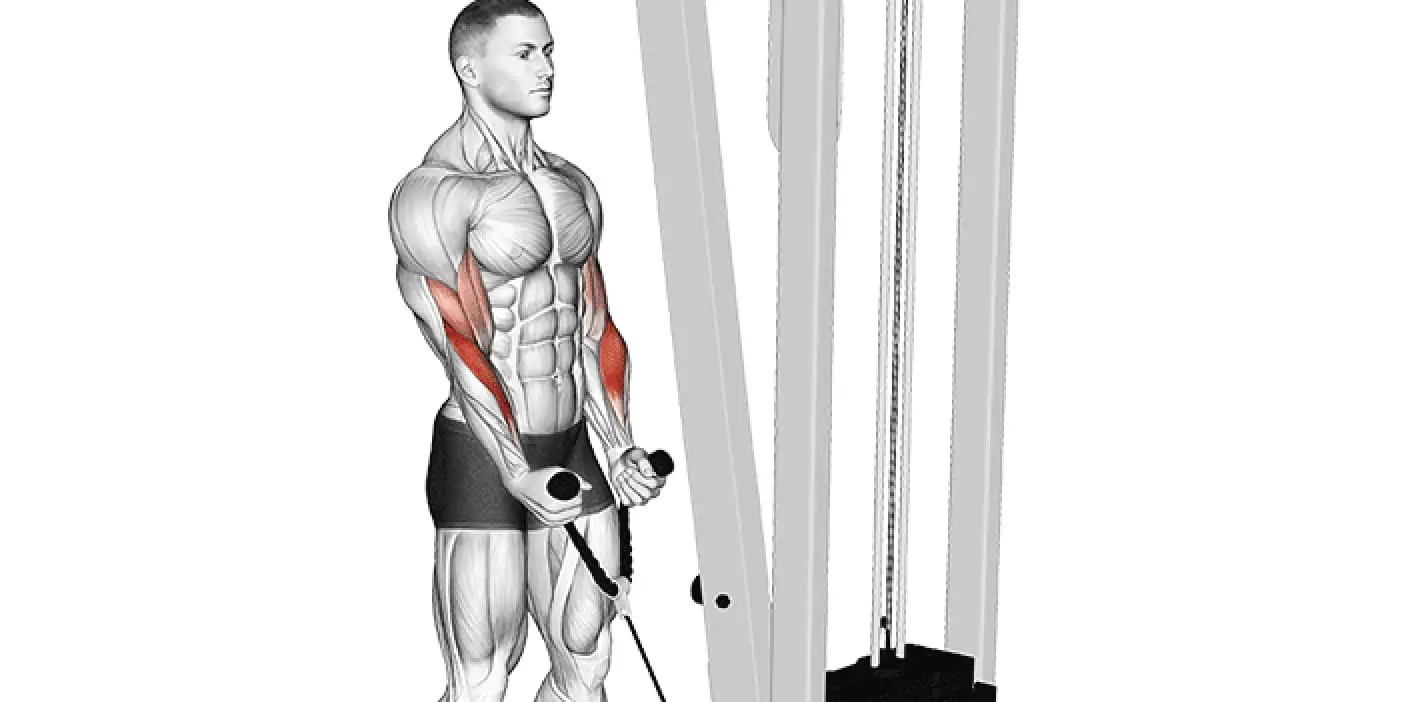
The cable rope hammer curl is an arm exercise performed with a rope attachment on a low cable pulley. You hold the rope with your palms facing each other and bend your elbows to bring your hands toward your shoulders.
The neutral grip trains the biceps brachii, brachialis and brachioradialis. Compared with dumbbell hammer curls, the cable version lets you adjust the direction of resistance by changing your position relative to the pulley.
In this guide, you’ll learn how to perform cable rope hammer curls with proper form, which muscles they work, common mistakes to avoid, how to program the exercise, and when to choose a variation.
Muscles Worked by Cable Rope Hammer Curls
Cable rope hammer curls train the muscles that bend your elbows. The main contributors are the brachialis, brachioradialis and biceps brachii, while the forearm and trunk muscles help maintain your grip and position.
Brachialis
The brachialis lies underneath the biceps brachii and helps bend the elbow. It contributes to elbow flexion regardless of whether your palms face up or face each other.
Brachioradialis
The brachioradialis is a forearm muscle that assists with elbow flexion. It is active during hammer curls and helps control the movement as you raise and lower the rope.
Biceps brachii
The biceps brachii contributes to elbow flexion during the exercise. Because the palms remain facing each other, the movement differs from a traditional palms-up curl, but it still trains the biceps.
Grip position can affect muscle activity, but it does not prove that one curl variation produces greater long-term muscle growth. A small study comparing curl grips found differences in muscle excitation, but it did not test long-term growth from cable rope hammer curls specifically. Read the research on curl grips.
Supporting muscles
The forearm muscles help hold the rope and keep your wrists stable. Your abdominal and back muscles also help keep your torso steady while you curl.
How to Perform the Cable Rope Hammer Curl
Equipment and setup
You need a cable machine with a low pulley and a rope attachment.
- Attach the rope to the lowest pulley setting.
- Stand facing the machine with your feet approximately shoulder-width apart.
- Hold one end of the rope in each hand, with your palms facing each other and your thumbs pointing upward.
- Stand close enough to maintain cable tension through a comfortable range of motion. The ideal distance depends on the machine and pulley arrangement.
- Keep your torso upright, brace your core and position your elbows close to your sides.
Step-by-step instructions
- Start with control. Let your arms extend toward the floor without allowing the weight stack to pull you out of position.
- Curl the rope. Bend your elbows and bring your hands toward your shoulders. Keep your upper arms relatively still.
- Avoid swinging. Use your arm muscles to move the weight instead of leaning backward or thrusting your hips forward.
- Pause briefly. At the top, squeeze the working muscles without forcing your wrists or elbows into an uncomfortable position.
- Lower slowly. Return the rope toward the starting position under control.
- Repeat. Maintain the same technique for every repetition.
Form cues to remember
- Keep your palms facing each other.
- Keep your wrists aligned with your forearms.
- Keep your elbows close to your sides without forcing them into a rigid position.
- Use a comfortable, controlled range of motion.
- Lower the weight deliberately rather than letting the cable pull your arms down.
- Reduce the load if you need to swing your torso or shorten the movement to complete a repetition.
You can allow the rope ends to separate slightly at the top if that feels natural, but it is optional. It is not a requirement for an effective repetition.
Common Cable Rope Hammer Curl Mistakes
1. Using too much weight
A load that is too heavy can make you swing your body or move your elbows to finish each repetition. Choose a weight you can control through the intended range of motion.
2. Swinging your torso
Leaning backward or thrusting your hips uses momentum to move the rope. Keep your torso steady and reduce the weight if you cannot curl without swinging.
3. Letting your elbows move excessively
Allowing your elbows to travel forward can change the movement and involve more shoulder motion. Keep them close to your sides while allowing a small, natural amount of movement if needed for comfort.
4. Bending your wrists
Avoid curling your wrists forward or letting them bend backward under the load. Keep them comfortably aligned with your forearms and hold the rope securely without squeezing it unnecessarily hard.
5. Cutting the range of motion short
Repeatedly performing only the easiest part of the movement can limit the work done through the full range. Use a comfortable range you can control, extending and bending your elbows without snapping into the end position.
6. Dropping the weight too quickly
Letting the cable pull your hands back removes control from the lowering phase. Return the rope steadily and keep your posture stable.
Benefits of the Cable Rope Hammer Curl
Trains several elbow flexors
The exercise works the brachialis, brachioradialis and biceps brachii. It can complement other curls that use a different grip.
Offers a neutral-grip option
The palms-facing-each-other position provides an alternative to palms-up curls. Choose the grip that feels comfortable and lets you perform the movement with control.
Allows adjustable resistance
A cable machine makes it straightforward to change the selected load in small increments, depending on the equipment available.
Fits into many arm workouts
Cable rope hammer curls can be used as accessory work after larger pulling exercises or alongside other arm exercises in a dedicated workout.
Cable Rope Hammer Curl Variations
Single-arm cable rope hammer curl
Perform the curl one arm at a time using one end of the rope or a compatible single-hand attachment. This lets you concentrate on each side separately and notice differences in control.
Seated cable hammer curl
If your setup permits a secure seated position, performing the curl while seated can reduce the opportunity to use your legs or torso for momentum. Keep your posture comfortable and the cable path clear.
Cable rope preacher hammer curl
The preacher setup supports the upper arms on a pad and can help limit unnecessary movement. See the Cable Rope Preacher Hammer Curl guide for this variation.
Dumbbell hammer curl
Dumbbell hammer curls use the same neutral grip without a cable machine. Each arm holds its own weight, making the exercise convenient for home workouts or gyms without cable stations. See the Hammer Curl guide.
Cable Rope Hammer Curl vs. Dumbbell Hammer Curl
Both exercises use a neutral grip and train the elbow flexors. The main difference is how the resistance is applied and how you can position yourself.
| Feature | Cable rope hammer curl | Dumbbell hammer curl |
|---|---|---|
| Equipment | Cable machine and rope | Pair of dumbbells |
| Grip | Palms face each other | Palms face each other |
| Resistance | Direction depends on pulley and body position | Gravity pulls the dumbbells downward |
| Loading | Adjusted using the cable stack | Adjusted by changing dumbbells |
| Practical advantage | Easy to change the cable angle and load | Can be done in more locations and trains each arm independently |
Neither version is automatically better for everyone. Choose the cable version if you prefer the machine setup or want to adjust the resistance angle. Choose dumbbells if you want a simpler setup or do not have access to a cable station. You can also include both in a balanced training program.
How to Program the Cable Rope Hammer Curl
The right number of sets and repetitions depends on your overall training plan, experience and recovery. As a practical starting point, try the following:
- Sets: 2–4 working sets
- Repetitions: 8–15 per set
- Rest: Around 60–120 seconds, or longer if needed to maintain good technique
- Effort: Finish most sets with a small number of controlled repetitions still possible rather than forcing repetitions with poor form
How to progress
Start with a resistance that lets you complete your planned repetitions with consistent technique. Gradually add repetitions as the exercise becomes easier. When you can reach the upper end of your target range across all working sets, increase the resistance by a small amount and build the repetitions up again.
If the smallest available weight increase is too large, continue improving your repetitions and control before moving up. You do not need to increase the load every workout.
Where it fits in a workout
Cable rope hammer curls are an isolation exercise. They can follow compound pulling movements such as rows and pulldowns, or sit alongside other curls in an arm-focused session. Consider the total work your biceps and forearms already receive when deciding how many sets to add.
Safety and Form Considerations
Start with a light resistance while learning the movement. Increase the load only when you can maintain a stable torso, controlled wrists and consistent repetitions.
Keep the rope attachment secure, make sure the cable path is clear, and avoid jerking the weight or snapping your elbows straight. If the exercise causes sharp or persistent pain, stop rather than trying to push through it. Seek advice from a qualified healthcare professional if pain persists or you are unsure whether the movement is appropriate for you.
Alternatives to the Cable Rope Hammer Curl
If you do not have access to a cable machine or want to change your workout, consider these options:
Hammer curl
The dumbbell hammer curl uses the same neutral grip and is a straightforward substitute. See the Hammer Curl guide.
Alternate hammer curl
The alternating version lets you curl one dumbbell at a time. It can help you focus on each arm separately while maintaining the neutral grip. Read the Alternate Hammer Curl guide.
Cross-body hammer curl
In this variation, you bring the dumbbell toward the opposite shoulder instead of curling straight upward. It changes the movement path while retaining the neutral grip. Read the Cross-Body Hammer Curl guide.
Choose the option that fits your equipment, comfort and training goals. Consistent, controlled training matters more than choosing a particular curl variation.
Frequently Asked Questions
What muscles do cable rope hammer curls work?
They work the brachialis, brachioradialis and biceps brachii. The forearm muscles help maintain your grip and wrist position.
Are cable rope hammer curls good for biceps?
Yes. The biceps brachii contributes to the movement. The neutral grip also trains the brachialis and brachioradialis, making the exercise a useful complement to other curl variations.
Should my palms face each other throughout the curl?
Yes. Keeping your palms facing each other maintains the standard hammer-curl grip. Keep your wrists comfortable and aligned with your forearms.
How many sets and reps should I do?
A practical starting point is 2–4 sets of 8–15 controlled repetitions. Adjust the workload according to your experience, recovery and overall training program.
Are cable rope hammer curls better than dumbbell hammer curls?
Neither is universally better. Cables allow you to adjust the direction of resistance by changing your position, while dumbbells offer a simple setup and independent arm movement. Choose based on your needs and preferences.
Can beginners do cable rope hammer curls?
Yes. Beginners can start with light resistance, learn the movement and progress gradually. Focus on controlling the weight rather than lifting as much as possible.
What can I do if I do not have a cable machine?
Dumbbell hammer curls, alternate hammer curls and cross-body hammer curls are practical alternatives that retain a neutral grip.
Conclusion
The cable rope hammer curl is a useful accessory exercise for training the biceps, brachialis and brachioradialis with a neutral grip. Set up the low pulley securely, keep your torso steady, control each repetition and choose a load you can handle with good technique. Progress gradually and use the exercise alongside other movements that fit your training goals.